Estates and Inherited Property in Malaysia
What happens to property after a death, which route applies, who the entitled beneficiaries are, and how long each route takes.
Updated 26 September 2026 · Written and reviewed by Nur Nabilah Binti Mohd Aris

For inherited property in Malaysia, a death does not transfer title automatically. Until the transfer to the beneficiaries is registered, the property remains in the deceased's name and cannot be sold or charged. Which route applies depends on the type and value of the assets, and on whether the deceased left a will.
What this inherited property in Malaysia guide covers
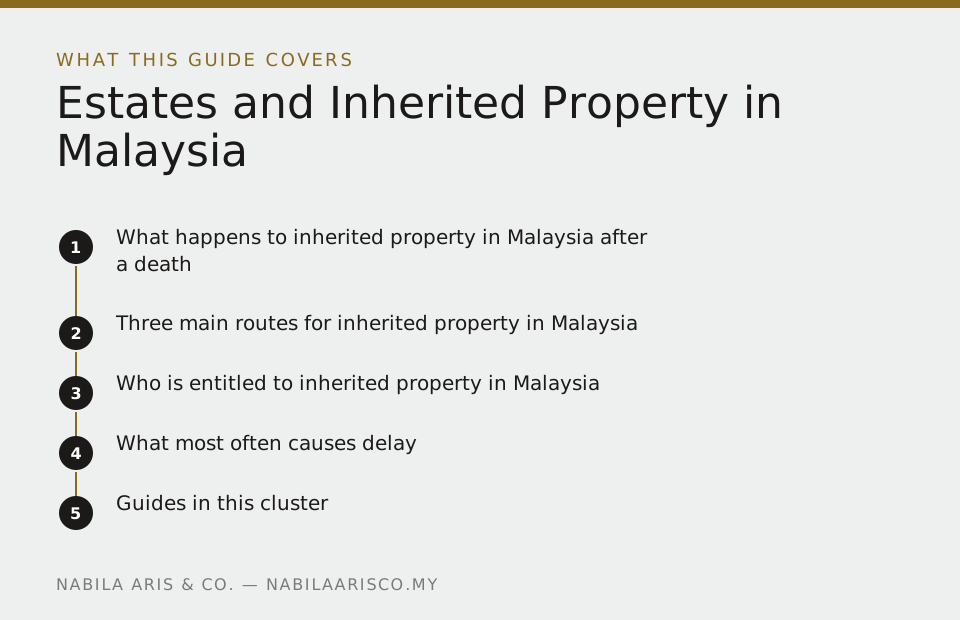
When someone dies, their property does not pass to the beneficiaries automatically. The name on the title stays the same until the estate application is completed and the transfer is registered at the land office.
This page sets out the routes available, who is entitled, and what most often holds an estate matter up. Each topic has its own guide.
What happens to inherited property in Malaysia after a death
Until the estate transfer is registered, the property remains in the deceased’s name on the record. The practical effects:
- It cannot be sold, because the registered proprietor cannot sign anything
- It cannot be charged as security for a loan
- No transfer to anyone can be registered
- Quit rent, assessment and maintenance become difficult to deal with
Three main routes for inherited property in Malaysia
Which route applies depends on the type of assets left behind, their value, and whether the deceased left a will.
- Small estate. An administrative route through the land office for estates that meet the conditions under the Small Estates (Distribution) Act 1955.
- Probate. A court application where the deceased left a will, made by the executor named in it.
- Letters of administration. A court application where there is no will, made by a beneficiary applying to administer the estate.
Who is entitled to inherited property in Malaysia
For Muslims, distribution follows faraid, and the shares are confirmed through a faraid certificate from the Syariah Court. For non-Muslims with no will, distribution follows the Distribution Act 1958.
A will changes this picture but does not remove the need for an application. The executor must still obtain probate before acting.
What most often causes delay
- Beneficiaries who cannot be traced or do not agree
- Several generations having died with no estate resolved
- Incomplete documents, particularly proof of family relationships
- An unresolved matrimonial property claim
- Property under charge, so the bank has to be brought in
Guides in this cluster
What to do in the first month
Obtain several copies of the death certificate. Almost every party you deal with needs one, and getting more copies later takes time.
Run an official title search on each property. It shows how the deceased’s name is recorded, whether there is a charge, and whether there is a caveat.
Gather the family documents: birth certificates, marriage certificates and identity cards for each beneficiary. If a beneficiary has died, their death documents are needed too.
Do not distribute any asset before the route is settled. Early distributions made in good faith often have to be unwound later.
Why families get stuck
The first reason is not knowing which route applies, so nothing gets started.
The second is waiting for every beneficiary to agree completely before beginning. Full agreement helps, but its absence does not prevent an application.
The third is assuming it is too expensive. The cost of delay is almost always higher than the cost of resolving it, particularly once tax arrears accumulate and further beneficiaries die.
There is also a route that avoids the estate process entirely. A hibah, a gift made during the owner’s lifetime, transfers the property while the owner is alive, so it never forms part of the estate. It has to be done properly and while the owner has capacity.
Frequently asked questions about inherited property in Malaysia
Why does the title not change automatically after a death?
Registration of title is a separate process. Until the estate application is completed and the transfer registered, the land office record still shows the deceased as the registered proprietor.
We live in the house. Does it need dealing with now?
Living there is not the same as owning it on the record. While it is unresolved the property cannot be sold or charged, and each further death among the beneficiaries makes the process harder.
How long does the whole process take?
It depends on the route, how complete the documents are, and whether all beneficiaries agree. A small estate at the land office is usually faster than a court application.
Do all the beneficiaries have to attend?
All beneficiaries must be given notice. Physical attendance by each of them is not always required, but their agreement affects how quickly the matter moves.
Ready to start your property matter?
An initial consultation with no obligation. Tell us about your matter and we will explain what is involved and what it is likely to cost.
No 1, Jalan Setia Dagang AL U13/AL, Setia Alam, 40170 Shah Alam, Selangor
014-4004293 · Monday to Friday, 9:00am to 5:00pm