Cost of Probate and Letters of Administration
What makes up the cost of a probate application where there is a will, and letters of administration where there is none, including the surety bond issue.
Updated 3 September 2026 · Written and reviewed by Nur Nabilah Binti Mohd Aris

The cost of probate depends on the value of the estate, the number of beneficiaries and whether the application is contested. Probate is applied for where the deceased left a will. Letters of administration are applied for where there is none. Both go through the courts, so they cost more than a small estate. The cost is made up of legal fees, court filing fees, searches, and in some letters of administration cases, costs relating to a surety bond.
What this cost of probate guide covers
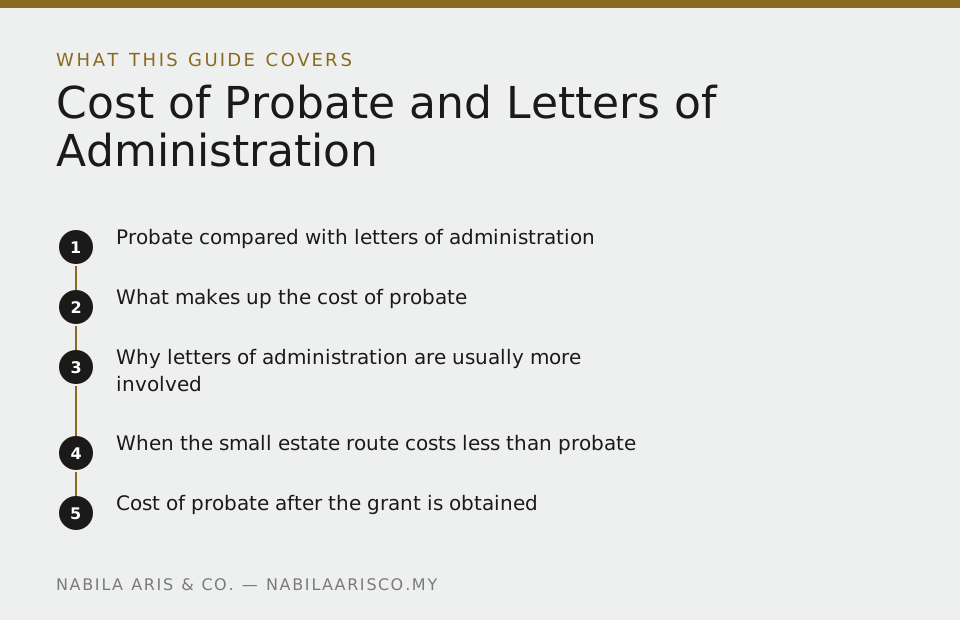
When someone dies, their property does not pass automatically to the beneficiaries. Someone has to be properly appointed to administer the estate. Who is appointed, and by which route, turns on one basic question: is there a will.
Probate compared with letters of administration
- Probate is applied for where there is a valid will. The executor named in the will applies to the court to confirm their authority. This is handled under the Probate and Administration Act 1959.
- Letters of administration are applied for where there is no will. An eligible beneficiary applies to be appointed as administrator. Distribution then follows the law applicable to the deceased.
What makes up the cost of probate
- Legal fees. Reviewing the will or determining the entitled beneficiaries, preparing affidavits and supporting documents, filing, and dealing with any court queries.
- Court filing fees. Charged by the court according to the type of application.
- Searches and verification. Title searches, and confirming the assets and liabilities of the estate.
- Surety bond. In some letters of administration applications the court requires sureties or a bond. This can add cost and complication, particularly where suitable sureties are hard to find.
- Registration after the grant. Once the grant of probate or letters of administration is obtained, the transfer to the beneficiaries still has to be registered at the land office.
Why letters of administration are usually more involved
With a will, the document already states who is responsible and how the estate is to be divided. Without one, both have to be established. Beneficiaries have to be identified, their entitlement confirmed, and their consent obtained to the appointment of an administrator. Where there are many beneficiaries or they disagree, cost and time both rise.
When the small estate route costs less than probate
If the estate meets the small estate conditions under the Small Estates (Distribution) Act 1955, that route is usually cheaper and faster because it is handled administratively. Your lawyer should assess eligibility for it before filing in court.
Cost of probate after the grant is obtained
As with a small estate, the grant itself does not change the name on the title. Once the grant is obtained, the executor or administrator has to deal with the transfer and register it. If the property is later sold, that sale carries the usual conveyancing costs and real property gains tax considerations.
| Holding period | Citizen & PR | Company | Non-citizen |
|---|---|---|---|
| Year one | 30% | 30% | 30% |
| Year two | 30% | 30% | 30% |
| Year three | 30% | 30% | 30% |
| Year four | 20% | 20% | 30% |
| Year five | 15% | 15% | 30% |
| Year six and beyond | 0% | 10% | 10% |
What slows things down and adds cost
- The original will cannot be found, only a copy
- The named executor has died or declines to act
- Assets in several states or overseas
- Unsettled estate debts that have to be identified first
- Incomplete death certificates or beneficiary identity documents
What drives up the cost of probate applications
The number of beneficiaries is the biggest factor. Each must be notified, and each additional signature means more work, particularly where someone lives overseas.
Scattered assets also raise the cost. Property in several states means several searches and several registrations, each with its own cost.
An objection changes everything. An unopposed application is an administrative matter. A contested one becomes litigation, and the cost moves with the number of hearings.
If you are not sure which route applies
Start by checking the type of assets and their value. If the estate includes land and the value falls within the small estate threshold, that route is usually the cheapest and fastest.
If there is a will, probate is the correct route even though the small estate route looks cheaper. The will has to be proved before the executor can act.
If there is no will and the estate does not qualify as a small estate, letters of administration is the route. Check this early so that you do not file in the wrong forum and have to start again.
The small costs that add up
Beyond legal fees and court filing fees, several smaller costs are rarely mentioned early but appear in almost every matter.
Affidavits must be sworn before a commissioner for oaths. A fee applies for each affidavit and for each exhibit attached to it. In an estate application the number of exhibits can be large, because every death certificate, title and bank statement is attached separately. One affidavit with fifteen exhibits costs more than people expect.
There is also stamp duty adjudication. For certain documents the instrument is submitted to the revenue authority for assessment of duty before it can be stamped. A fee applies to that application, and the process takes its own time.
Individually these costs are small. Combined across a substantial application with many documents, they come to an amount worth putting in the budget from the start.
Frequently asked questions about cost of probate
Does a will avoid court costs entirely?
Not entirely, but it usually simplifies matters. With a will the executor still has to apply for probate, but does not have to establish who the entitled beneficiaries are or obtain their consent to the appointment.
What is a surety bond and when is it needed?
In some letters of administration applications the court requires security to protect the estate. Whether it is required depends on the circumstances and it can add cost.
Can more than one person apply?
Yes, in many situations more than one person can be appointed jointly. This is sometimes needed where beneficiaries want joint representation.
What if the executor declines to act?
An executor may renounce the appointment. In that case the route depends on the terms of the will and whether a substitute executor is named.
Why did the affidavit cost more than I expected?
Because a fee applies per exhibit, not once per affidavit. Estate applications usually carry many exhibits such as death certificates, titles and bank statements.
What is stamp duty adjudication?
For certain documents the instrument is submitted to the revenue authority for assessment of duty before it can be stamped. There is a fee for that application, and it takes its own time.
Ready to start your property matter?
An initial consultation with no obligation. Tell us about your matter and we will explain what is involved and what it is likely to cost.
No 1, Jalan Setia Dagang AL U13/AL, Setia Alam, 40170 Shah Alam, Selangor
014-4004293 · Monday to Friday, 9:00am to 5:00pm