Small Estate, Probate or Letters of Administration
The three routes for administering an estate, what decides which one applies, and how they differ in cost and time.
Updated 4 September 2026 · Written and reviewed by Nur Nabilah Binti Mohd Aris

Choosing between small estate or probate depends on the value of the estate, the type of assets and whether there is a will. The route is decided by the assets, their value, and whether there is a will. A small estate through the land office is usually the simplest. Probate applies where there is a will. Letters of administration apply where there is no will and the estate does not qualify as a small estate.
What this small estate or probate guide covers
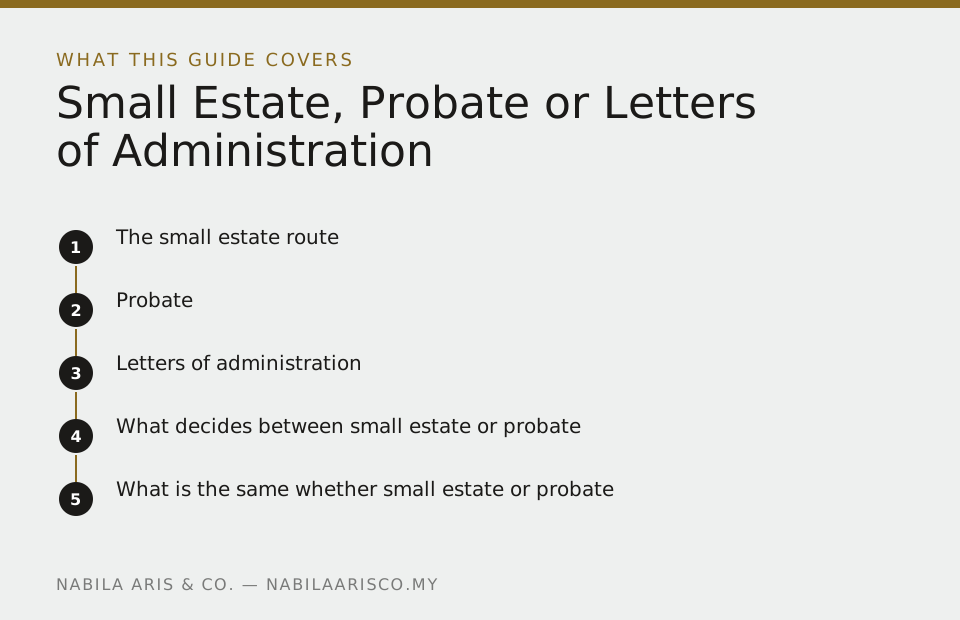
There are three routes for administering an estate in Malaysia. Which one applies is decided by the circumstances of the estate, not by the family’s choice.
The small estate route
This is an administrative route through the land office under the Small Estates (Distribution) Act 1955. It applies where the estate includes landed property and meets the conditions set out in that Act.
Because it is administrative rather than a full court proceeding, it is usually simpler and cheaper. The application is filed at the land office for the district where the land is situated, notice is given to all beneficiaries, and a hearing is held before the distribution order is made.
Probate
Probate applies where the deceased left a will. The named executor applies to court to prove the will, and once the grant issues, the executor can act for the estate.
Letters of administration
This applies where there is no will and the estate does not qualify for the small estate route. A beneficiary applies to court to be appointed administrator. Depending on the circumstances, sureties or a bond may be required.
What decides between small estate or probate
- Whether the deceased left a will
- Whether the estate includes landed property
- The value and composition of the assets left behind
- Whether all beneficiaries are identified and contactable
What is the same whether small estate or probate
Every route requires the entitled beneficiaries to be identified, the supporting documents to be complete, and notice to be given. Every route also ends the same way: a transfer registered at the land office so that the name on the title finally changes.
What happens if you choose the wrong route
Filing in the wrong forum means the application is rejected or returned, and you start again in the right one. The cost and time already spent are not recoverable.
The most common examples are filing a small estate application where the estate contains assets that put it outside that unit’s jurisdiction, or applying for letters of administration where a will in fact exists.
Check the type and value of the assets, and establish whether a will exists, before anything is filed.
What is the same on every route
Every route needs the death certificate, the deceased’s identification, a list of assets, and evidence of each beneficiary’s relationship.
Every route requires beneficiaries to be notified. Concealing an application from the others is a frequent cause of it being set aside and of disputes.
Every route ends with a separate registration step for land. An order or a grant does not change the name on the title by itself.
And every route becomes more complicated the longer it is left.
Cost compared: small estate or probate and the third route
The small estate route is usually the cheapest because it is handled by an administrative unit rather than a court.
Probate costs more because it is a court application, but it is simpler than letters of administration because the will already names the executor.
Letters of administration is usually the highest because it needs the beneficiaries’ consent, sureties in certain cases, and more supporting documents.
On all three routes the cost rises with the number of beneficiaries and the state of the documents, not simply with the value of the property.
Questions worth asking before filing
Whether a will exists, and whether a reasonable search has been made.
What the list of assets is and their approximate value.
On that basis, which forum is correct.
Who all the beneficiaries are, and whether they can all be contacted.
What happens if we file in the wrong forum.
Where the land has been left unclaimed for years, the same routes apply but the cost and documents grow. See unclaimed inherited land.
What makes a will valid is set out in the Wills Act 1959.
Whichever forum applies, notice has to reach every beneficiary. What happens when they do not agree is set out in beneficiaries who disagree.
Frequently asked questions about small estate or probate
Can we simply choose the cheapest route?
No. The route is decided by the circumstances of the estate, not by the family's preference. What you can control is whether the documents are complete so that the applicable route runs smoothly.
There is property in more than one state. What then?
A small estate application follows where the land is situated. Where property spans more than one district or state, the sequence needs planning at the start.
The deceased left only shares and bank accounts, no land. What now?
Where there is no landed property, the land office small estate route does not apply. It goes through the courts or through Amanah Raya, depending on the circumstances.
Ready to start your property matter?
An initial consultation with no obligation. Tell us about your matter and we will explain what is involved and what it is likely to cost.
No 1, Jalan Setia Dagang AL U13/AL, Setia Alam, 40170 Shah Alam, Selangor
014-4004293 · Monday to Friday, 9:00am to 5:00pm