Unclaimed Inherited Land: Why Waiting Costs More
Land left in a deceased name for years: what happens to quit rent, why the number of heirs multiplies each generation, and where to start.
Updated 8 November 2026 · Written and reviewed by Nur Nabilah Binti Mohd Aris
Unclaimed inherited land stays registered in the name of an owner who has died, and quit rent keeps accruing until it becomes arrears. The land cannot be sold, charged or subdivided while the estate remains unresolved. Every generation that passes multiplies the number of heirs, so cost and duration rise with waiting. The first steps are an official title search and assembling the list of heirs by generation.
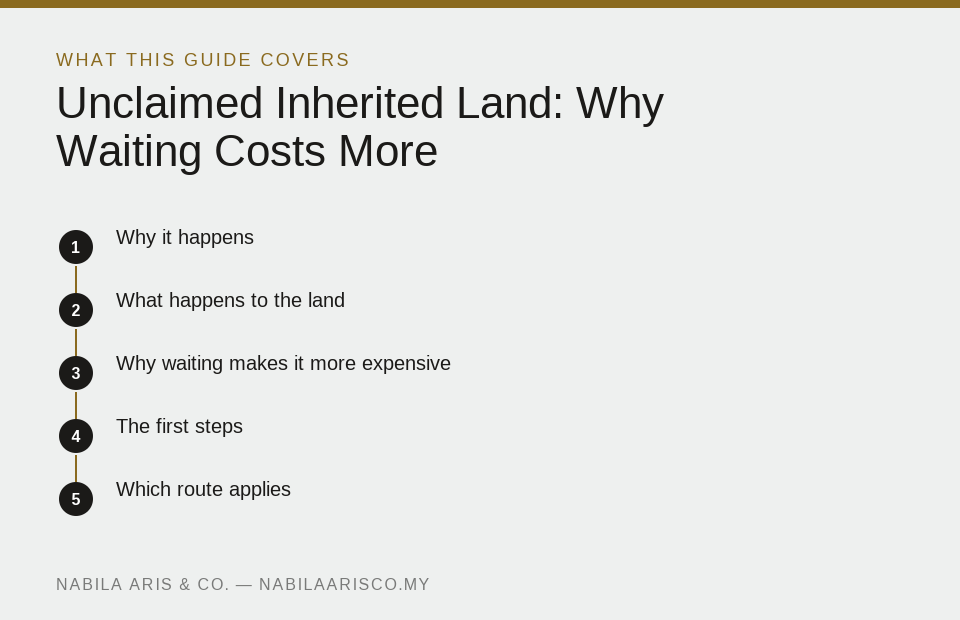
What this unclaimed inherited land guide covers
Some estates are never claimed. Not because there are no heirs, but because nobody starts the process. The land stays in the deceased name, year after year, until someone tries to sell and the problem surfaces.
Why land becomes unclaimed inherited land
Usually not because of a dispute. The most common reasons are far more mundane.
Heirs assume the estate lapses by itself after long enough. Or they know it needs dealing with but nobody wants to begin. Or the land is modest in value and the cost seems not worth it. Or the original title document is lost and nobody knows the first step.
Meanwhile heirs die one by one, and each death adds a fresh layer of estate on top of the old one.
An estate does not lapse by itself however long it is left. The land stays registered in the deceased name, quit rent keeps accruing, and in extreme cases the land can be forfeited for arrears.
What happens to unclaimed inherited land
The land does not disappear. It stays registered in the original owner name, and quit rent keeps accruing.
Quit rent arrears are a real problem. The land office will not register any dealing while they remain unpaid, and in extreme cases land can be forfeited for arrears.
At the same time the land cannot be sold, charged, subdivided or used as security. It is an asset nobody can touch.
Why waiting makes unclaimed inherited land more expensive
This is the main reason we wrote this guide. Every generation that passes multiplies the number of heirs.
One parcel with three children becomes a parcel with perhaps twelve grandchildren. Each has to be identified, traced, and either consent or be given notice. Some have moved abroad. Some are no longer in contact with the family.
A case that could be resolved in months in the first year can take years after two generations.
The first steps with unclaimed inherited land
- Official title search. Confirm who the registered owner is and what is endorsed on the title. This can be done even if the original document is lost.
- Death certificates. For every person in the chain, not only the original owner.
- List of heirs. Arranged by generation, including those who have since died.
- Check quit rent arrears at the district land office.
Which route applies to unclaimed inherited land
For a modest estate consisting of land with no will, the small estate route through the Estate Distribution Unit is usually more suitable than the court. It was designed for exactly this kind of case.
Where there is a will, or where the value exceeds the threshold, a different route applies. We can check which after seeing the title search and the list of heirs.
A lost title document is not a barrier. There are procedures to obtain a copy or replace it.
If the land is of modest value
The honest question: is it worth dealing with village land worth only tens of thousands?
It depends. But the cost will not get cheaper by waiting, and the number of heirs will not shrink. If the family intends to sell one day, earlier is cheaper.
The order of work where estates sit on top of each other
Where more than one generation has died, the work runs from the top down.
The first step is establishing the registered owner from a land search, and identifying who the beneficiaries were at the date of that death.
The second is resolving the estate of the original owner first, so that each first generation share is fixed.
The third is resolving the estate of each first generation beneficiary who has since died, one at a time.
Only at the fourth step can the shares of the people living today be settled.
The fifth is registering the transfer at the land office, once the arrears are cleared.
The documents needed for each generation
A death certificate is needed for every person in the chain, not only the original owner. In an old matter this is the part that takes the longest.
Birth certificates or other records are needed to show the relationship between each generation.
A marriage certificate is needed where a surviving spouse falls within the list of beneficiaries.
Identity documents are needed for every living beneficiary, and the spelling has to be checked against older records that may spell the same name differently.
Where a record is missing, a copy can be applied for from the registry, but that application takes time of its own and should be started early.
What most often holds an old land matter up
Beneficiaries who cannot be traced. Old addresses no longer hold and telephone numbers are long dead.
Incomplete registry records for deaths that happened many years ago, particularly in rural districts.
Names spelt differently across the title, the birth certificate and the identity card. Every difference has to be explained before registration can proceed.
Substantial quit rent arrears. The land office will not register a transfer while they remain outstanding. See our guide on quit rent arrears.
A missing original title. There is a procedure to replace it, but it is a separate matter. See lost title deed.
The mistakes we see most often in old land matters
Waiting until a buyer appears. Buyers rarely wait as long as a stacked estate takes to resolve.
Resolving only the most recent death and skipping the earlier ones. The chain has to be complete from the registered owner downwards.
Dividing the land verbally among the family and marking boundaries informally. A division that is not registered counts for nothing on the register.
Stopping once the order is obtained and never completing the registration. The land stays in the old name and the same problem returns for the next generation.
Common questions about unclaimed inherited land
Does an estate lapse simply because time has passed? No. The land stays registered in the name of the original owner. What grows is the number of beneficiaries, the difficulty of tracing them, and the cost of putting it right.
Can one beneficiary start the application without the others? Yes, though everyone still has to be notified and given the chance to state a position.
Can the land be claimed if the document of title is gone? Yes. An official search still shows the position on the register, and the title document can be dealt with separately.
What if someone else occupies or farms the land? Occupation does not change the name on the title, but it should be mentioned to the lawyer because it affects what happens after registration.
Which route applies to an old matter? That depends on the assets left behind and whether a will exists. See which estate route applies.
I appointed them to handle my parents property matter and everything was handled smoothly and professionally. She explained everything clearly, was very patient with all of our questions and kept us updated throughout the process.
Athirah Azham · Google
Patient, takes the time to explain every term and procedure in detail, and has been very efficient in providing timely updates throughout the process. Whether you are purchasing a home for the first time or have been through the process before.
Aifa Azmi · Google
Excellent service throughout my property transfer transaction. The conveyancing team was professional, responsive, and efficient, keeping me informed at every stage.
Marina Mardi · Google
Rated 5.0 from 9 Google reviews.
Frequently asked questions about unclaimed inherited land
The land has been in a deceased name for years, can it still be claimed?
Yes. No period of time extinguishes the rights of heirs. What changes is the cost and complexity, because the number of heirs grows each generation.
The original title document is lost, what now?
Not a barrier. An official search can be done without it, and there are procedures to obtain a copy or replace it.
The village land is of modest value, is it worth dealing with?
It depends on the family plans. But the cost will not get cheaper by waiting, and the number of heirs will not shrink.
Ready to start your property matter?
An initial consultation with no obligation. Tell us about your matter and we will explain what is involved and what it is likely to cost.
No 1, Jalan Setia Dagang AL U13/AL, Setia Alam, 40170 Shah Alam, Selangor
014-4004293 · Monday to Friday, 9:00am to 5:00pm