Letters of Administration
Applying for letters of administration in the High Court where the deceased left no will, enabling the administrator to collect and distribute the estate.

Letters of Administration are applied for at the High Court where the deceased left no will and the estate does not qualify as a small estate. The grant gives the appointed administrator authority to collect, manage and distribute the estate under the applicable law. A small estate is handled at the land office where it includes immovable property and the total does not exceed RM2,000,000. Movable property alone not exceeding RM600,000 can be administered by Amanah Raya without going to court.
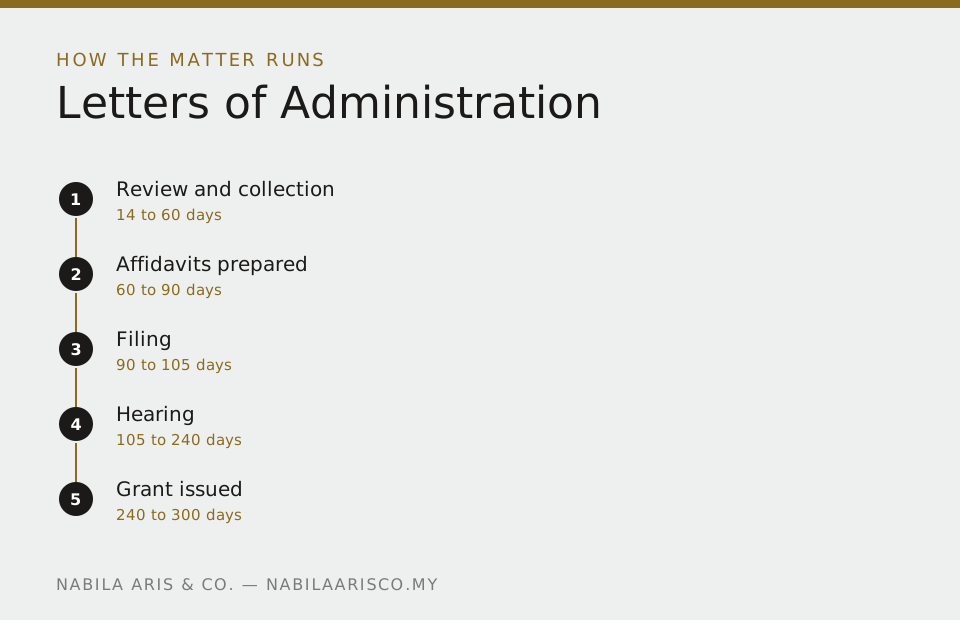
The letters of administration process step by step
When a person dies without leaving a will, no one has automatic authority to deal with their assets. Banks will not release funds, the land office will not register a transfer, and insurers will not pay a claim to a beneficiary who has no lawful authority.
Letters of administration are the court order that gives that authority.
The right forum for letters of administration
Not every estate needs to go to the High Court. Where the estate includes land and the value falls within the prescribed limit, the Estate Distribution Unit is the more appropriate forum, with a simpler process and lower cost.
Determining the correct forum at the outset saves time and cost. Filing in the wrong forum means starting again.
Three forums, and the values that decide between them
The first question is not how to apply but where. The answer is set by the type of property and its value, not by what the family would prefer.
| Forum | When it applies | What it issues |
|---|---|---|
| Land Office (Estate Distribution Unit) | Small estate: includes immovable property, and the total of immovable and movable property does not exceed RM2,000,000 | Distribution Order (Form E) or Supplementary Order (Form T) |
| Amanah Raya Berhad | Movable property only, not exceeding RM600,000 | Summary administration, without going to court |
| High Court | Everything else, including higher value estates and any case with a will | Letters of Administration, or a Grant of Probate where there is a will |
The RM2,000,000 figure comes from the Small Estates (Distribution) Act 1955, and the RM600,000 limit applies to Amanah Raya summary administration of movable property.
Forms and documents
For the small estate route at the land office, the opening document is Form A, the petition. It must be signed before a Commissioner for Oaths, a Magistrate, or the Land Administrator.
Form A asks for the following, and an incomplete answer to any one of them is the most common cause of delay:
- The petitioner and their relationship to the deceased
- Date and details of death, supported by the death certificate
- A full list of estate assets: land, bank accounts, vehicles, shares, EPF
- A list of the deceased’s debts, including charges and personal loans
- A full list of surviving beneficiaries
After the hearing the land office issues Form E, the Distribution Order, or Form T, a Supplementary Order where assets surface later.
A High Court application uses an entirely different set of documents, prepared by a solicitor: the petition, a supporting affidavit, a schedule of assets, and written consents from the other beneficiaries.
Who may apply
Not only the beneficiaries. For Letters of Administration at the High Court, those who may apply include:
- Beneficiaries of the deceased: widow or widower, sons or daughters, parents, siblings
- Creditors of the deceased
- A purchaser with an interest in the estate
- Trustees
- Government authorities with a relevant interest
In practice nearly every application comes from a beneficiary. But where no beneficiary is willing to take the role, a creditor may apply, and the estate is then administered by someone whose interest is not the family’s.
Sureties: when they are required and how many
This is the part that catches families out, and it should be dealt with early.
For a High Court application, two fit and proper sureties are required where the value of the estate exceeds RM50,000.
There are two ways out when a family cannot find two sureties:
- Apply for an exemption. The court may dispense with the requirement in certain circumstances. It is not automatic and must be supported by reasons.
- Professional sureties. Insurance companies and banks provide sureties for a fee. This is the usual route for families with no other option.
Consent of beneficiaries in a letters of administration application
The application runs more smoothly where beneficiaries agree on who is to be appointed administrator. Disagreement at this stage is the most common cause of delay and can add months to the process.
Responsibilities after letters of administration are granted
An administrator is not simply a name on a document. The grant confers authority; it does not complete the distribution.
The administrator is responsible for collecting the assets, settling the debts of the deceased, and only then distributing the balance to the beneficiaries under the applicable law or under faraid. Those responsibilities carry liability, and should be understood before someone agrees to be appointed.
For land, a further step is needed to register the transfer from the deceased’s name into the beneficiaries’ names. Until that is done the property still cannot be sold in the ordinary way.
Keep a record of every payment and every distribution. Disputes between beneficiaries often surface years later, and orderly records are an administrator’s best protection.
Choosing a suitable administrator
The administrator is not just a name on a document. That person deals with the bank, the land office and the other beneficiaries, and is personally answerable if the estate is handled carelessly.
Choose someone reachable, living near the assets if possible, and able to keep records. A beneficiary living overseas can be appointed, but every signature will take longer.
The surety requirement is set out above. Look for them early, because finding people willing to stand as surety often takes longer than expected.
Renouncing the right to administer
Not every beneficiary wants to take on the administrator role. The duties are real: gathering assets, settling debts, and distributing the remainder correctly, with accountability to the other beneficiaries.
A person entitled to apply may renounce that right. The renunciation is made in writing and filed with the application, not by verbal agreement at a family meeting.
One point to understand before signing: once the right is renounced, that person generally cannot change their mind and apply later without the leave of the court. Do not sign a renunciation merely to speed matters along if you may want to be involved later.
Renouncing the right to administer is not the same as giving up your share of the estate. You can decline to act as administrator and still receive your entitlement. They are entirely separate documents, and confusing the two is an expensive mistake.
What your lawyer handles
- Determining the correct forum, whether the High Court or the Estate Distribution Unit
- Preparing a schedule of the assets and liabilities of the deceased
- Identifying beneficiaries and obtaining consent on the appointment of an administrator
- Preparing the affidavits and application documents
- Attending to the sureties or administration bond where required
- Filing the application and appearing in court
- Attending to transfer of property once the court issues the grant
Timeline
Documents you need to prepare
- Death certificate of the deceased
- Copy of the identity card of the deceased and every beneficiary
- Documents proving the relationship of beneficiaries
- A complete schedule of assets including property, bank accounts, EPF, shares and vehicles
- A schedule of the debts of the deceased
- Written consent of beneficiaries to the appointment of the administrator
Costs people often overlook
- Legal fees for the application and court representation
- Court filing fees
- Cost of the administration bond or sureties if required
- Cost of asset searches and document certification
- Land office fee for registration of the transfer after the grant
- Service tax of 8% on legal fees
When to stop and get advice first
- Beneficiaries cannot agree on who should act as administrator
- The deceased has debts that are large in relation to the value of the estate
- There are minor beneficiaries, which requires additional consideration
- The estate includes property outside Malaysia
- A will surfaces later, after the application has begun
Frequently asked questions about letters of administration
How do I apply for letters of administration?
Decide the forum first. Where the estate includes immovable property and the total does not exceed RM2,000,000, file Form A at the Estate Distribution Unit of the land office. Otherwise the application is made at the High Court through a solicitor.
When can Amanah Raya be used instead of the court?
Where the estate consists of movable property only and does not exceed RM600,000. Amanah Raya can then carry out a summary administration without a court application.
How many sureties are needed?
Two fit and proper sureties, where the value of the estate exceeds RM50,000. The court may dispense with the requirement in certain circumstances, and professional sureties are available from insurance companies and banks for a fee.
What are Form A, Form E and Form T?
Form A is the small estate petition, signed before a Commissioner for Oaths, a Magistrate or the Land Administrator. Form E is the Distribution Order issued after the hearing. Form T is a Supplementary Order used where assets surface later.
When are letters of administration needed rather than a small estate order?
Where the estate does not meet the small estate criteria, either because its value exceeds the limit or because it does not include immovable property.
Who can be the administrator?
Normally a beneficiary who has the consent of the other beneficiaries. The court makes the appointment on the application.
What is an administration bond?
A guarantee the court may require to ensure the administrator carries out their duties properly. Whether you need one depends on the circumstances.
How long does it take?
Usually six to twelve months, depending on how complete the documents are, the court calendar, and whether there is any objection.
Can beneficiaries withdraw money from the deceased's bank account first?
Not without lawful authority. Banks require letters of administration or an equivalent order before releasing funds.
The deceased left a will, is the process different?
Yes. Where there is a valid will, the appropriate application is for probate rather than letters of administration.
I do not want to be the administrator, can I step aside?
Yes. You make the renunciation in writing and file it with the application. Once renounced, you generally cannot apply later without the leave of the court.
If I renounce, do I lose my share?
No. Renouncing the right to administer and giving up your share of the estate are two separate documents. You can decline the role and still receive your entitlement.
Ready to start your property matter?
An initial consultation with no obligation. Tell us about your matter and we will explain what is involved and what it is likely to cost.
No 1, Jalan Setia Dagang AL U13/AL, Setia Alam, 40170 Shah Alam, Selangor
014-4004293 · Monday to Friday, 9:00am to 5:00pm