Subsale Conveyancing Lawyer for Buyers
We act for the buyer in a subsale purchase: reviewing and preparing the sale and purchase agreement, stamp duty, transfer of title, and coordination with the bank until the title is registered in your name.

A subsale lawyer acts for you as the buyer, from the title search through to registration of the transfer. For a subsale property at RM500,000 with a 90% loan, the buyer's legal fees are approximately RM6,250 for the sale and purchase agreement and RM5,625 for the loan documentation, both under the Solicitors Remuneration Order 2023, before 8% service tax. Transfer stamp duty is RM9,000. The full process normally takes three to four months from the date you sign the sale and purchase agreement.
The subsale lawyer process step by step
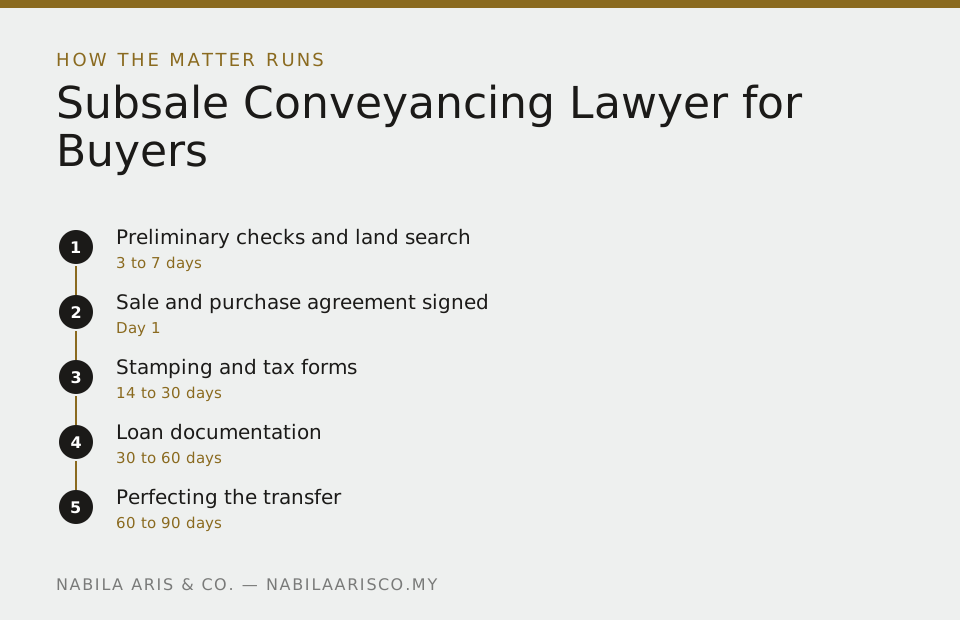
A subsale purchase means you are buying from an existing owner, not from a developer. The title already exists. So does the history attached to it: who owns the property, whether a bank holds a charge over it, whether a third party has registered an interest, and whether a restriction blocks the transfer.
Your lawyer’s job is to make sure you receive the property clean, and that the land office registers your name as the owner at the end of it.
Why a buyer needs their own subsale lawyer
In most bank-financed purchases, the bank appoints solicitors from its own panel to prepare the loan documents. Those solicitors act for the bank. Their job is to secure the bank position through the charge, not to look after yours.
The sale and purchase agreement between you and the seller is a separate document. It sets when you pay the deposit, what happens if the bank rejects your loan, who pays outstanding taxes, and how long the seller has to hand over vacant possession. That document is the one protecting you.
If the firm you choose already sits on your bank’s panel, one firm can handle both matters. Coordination gets easier, and you avoid the delays that build up when two firms wait on each other.
What your subsale lawyer checks before you sign
An official land search comes first. Run it before you sign the sale and purchase agreement, not after. The search shows the registered proprietor, the tenure, the restriction in interest if any, plus any charges and caveats.
Three findings come up again and again, and each one adds time:
- The title still carries the name of someone who has died, and nobody has administered the estate yet.
- The individual title has not issued, even though the developer completed the building years ago.
- A restriction in interest forces you to obtain State Authority consent first.
Some of them add cost as well.
Deposit and stakeholder money your subsale lawyer holds
The deposit is normally 10% of the purchase price, less any earnest deposit you already paid the estate agent. Your solicitors hold that money as stakeholder, and release it only once you meet the conditions in the agreement.
Should the seller push for an early release, raise it with your lawyer before you agree to anything.
The safe sequence for a subsale buyer
Getting the order right saves more money than negotiating the fee.
Start with the official title search, not with the agent’s booking form. Say the search turns up a deceased owner’s name, or a restriction in interest that needs state consent. At that point you can still walk away, and you lose nothing.
Negotiate the three terms that matter
Once the search comes back clean, negotiate the terms of the agreement. Three of them cause most of the later trouble:
- The completion period.
- What happens if the bank rejects your loan.
- Who pays outstanding assessment and quit rent up to the handover date.
Agree all three in writing before you pay the 10% deposit.
Line up the dates before you commit
Then line up the dates. Banks run their own schedule for valuation and release, and the land office runs a separate one for registration. If the completion date ignores either one, you end up applying for an extension and paying late interest you could have avoided.
The real timeline, week by week
The three to four month figure is an average. This is the breakdown, and where it stalls.
| Stage | Usual duration | What decides it |
|---|---|---|
| Official title search and bankruptcy search | 1 to 2 weeks | Which land office, and whether the title is master or individual |
| Preparing and signing the sale and purchase agreement | 1 to 2 weeks | How quickly both sides can get together to sign |
| Stamping and loan documentation | 2 to 4 weeks | Bank approval and the valuation |
| State authority consent, where the title carries a restriction | 2 to 4 months | Which state, and how complete the application is |
| Presentation of the transfer and registration | 2 to 6 weeks | Land office workload |
Look at the fourth row. A restriction in interest can double the overall period, and it is the one stage nobody can speed up. That is why the official search is done on day one, not after the deposit is paid.
Documents you need to prepare
The most common delay is not at the land office. It is on the buyer’s side. Have these ready before a file is opened:
- Identity card, front and back
- The booking form or the agent’s letter of offer
- The bank’s loan approval letter
- Three recent bank statements, if the bank asks for them
- EPF statement, if you are drawing on Account 2
- Property details: title number, lot number, full address
- For married buyers, the spouse’s identity card where the title will be in joint names
What the fee covers, and what it does not
Legal fees under the Solicitors’ Remuneration Order 2023 are statutory. They are the same at any firm. What differs between firms is disbursements and how the work is run.
| Covered by the fee | Disbursements, billed separately |
|---|---|
| Drafting and reviewing the sale and purchase agreement | Transfer stamp duty |
| Official title search and bankruptcy search | Land office search fees |
| Preparing the transfer instrument | Registration fee on the transfer |
| Dealing with the seller’s solicitor and the bank | Stamping fees |
| Holding stakeholder money | Stamping of the loan documents |
| Registering the transfer at the land office | Courier and document copies |
Service tax of 8% applies to the legal fee, not to disbursements.
When a matter stalls, and what to do about it
The three most common causes of delay, and the right response to each:
- The seller’s bank is slow with the redemption statement. This sits outside both solicitors’ control. What can be done is for your solicitor to chase the seller’s solicitor in writing, so there is a record if the completion period has to be extended.
- A restriction in interest requires state consent. The application is filed and then it waits its turn. Do not plan a moving date before the consent is out.
- The seller cannot be reached to sign. This is the most frustrating cause because it is not a technical problem. The agreement contains a default clause, and your solicitor should explain your options before the period expires, not after.
One warning sign worth taking seriously: if your solicitor cannot tell you which stage your matter is at and what is being waited on, that is not a matter being run carefully.
The most expensive mistakes in a subsale lawyer matter
First: paying earnest money to the agent before anyone runs a title search. You will struggle to recover that money if the deal collapses for a reason an early search would have caught.
Second: relying entirely on the bank panel lawyer. That lawyer prepares the security documents for the bank. Nobody obliges them to check whether your sale terms are fair, or whether the seller can actually deliver a clean title.
Third: signing the agreement without reading the vacant possession clause. If a tenant still occupies the property, or the seller does, and the agreement fixes no clear handover date, you can end up getting the keys months after paying in full.
For a shop, an office or a factory, further checks apply to the express condition and the licences. We set them out in buying commercial property.
Estimated fees by property price
The table below shows an estimate for a purchase with a bank loan at 90% margin, property in Selangor, citizen buyer. Legal fees are calculated under Solicitors Remuneration Order 2023, in force from 15 July 2023.
| Property price | Legal fees | Stamp duty | Estimated total |
|---|---|---|---|
| RM250,000 | RM6,413 | RM5,125 | RM13,538 |
| RM500,000 | RM12,825 | RM11,250 | RM26,075 |
| RM750,000 | RM18,090 | RM19,875 | RM39,965 |
| RM1,000,000 | RM23,220 | RM28,500 | RM53,720 |
| RM1,500,000 | RM33,480 | RM50,750 | RM86,230 |
What your lawyer handles
- Conducting an official land search to check the title before any agreement binds you
- Checking whether the property carries a caveat, an undischarged charge, or a restriction in interest you must resolve first
- Preparing or reviewing the sale and purchase agreement, including payment terms, the completion period, and what happens if either side defaults
- Holding the deposit as stakeholder money instead of releasing it to the seller before you meet the conditions
- Attending to stamping of the agreement and the transfer instrument with the Inland Revenue Board
- Coordinating with the seller's solicitors and your financing bank for settlement of the balance purchase price
- Presenting the transfer at the land office and monitoring registration through to completion
- Delivering the registered title to you, or to the bank if a charge sits over the property
Timeline
Documents you need to prepare
- Copy of the identity card of the buyer and spouse if buying jointly
- Copy of the title, or the original sale and purchase agreement if the property is still under the developer master title
- Letter of offer from the bank, if you are financing the purchase
- Proof of any earnest deposit paid to the estate agent
- EPF Account 2 statement if you intend to make a withdrawal for the purchase
- Salary slips or proof of income, for the bank
Costs people often overlook
- Official land search and bankruptcy search on the seller, usually a few hundred ringgit
- Land office registration fee for the transfer, for example RM400 in Selangor, and RM100 for registration of the charge
- Service tax of 8% on legal fees, in force since 1 March 2024
- Loan agreement stamp duty at 0.5% of the loan amount
- Quit rent and assessment, split between seller and buyer at the handover date
- A separate legal fee for the loan documentation, calculated on the loan amount rather than the property price
When to stop and get advice first
- The agent asks you to sign a booking form with an earnest deposit before anyone runs a land search
- The title still carries a previous owner name, or that of someone who has died whose estate nobody has administered
- The property carries a restriction in interest, so you need State Authority consent before the land office will register the transfer
- The seller presses you to release the deposit directly instead of holding it as stakeholder money
- There is a caveat lodged by a third party over the property
- The seller's outstanding loan is higher than the agreed sale price
Frequently asked questions about subsale lawyer
Can I use my own lawyer even though the bank has appointed one?
Yes. The bank's solicitors handle the loan documentation for the bank, while your solicitors handle the sale and purchase agreement and the transfer for you. These are different roles. If our firm sits on your bank's panel, we handle both together.
How much deposit do I need?
Normally 10% of the purchase price, less any earnest deposit already paid to the agent. The solicitors hold it as stakeholder money until you meet the conditions in the agreement.
How long does a subsale take?
Usually three to four months from the date you sign the sale and purchase agreement. It runs longer if the property needs State Authority consent, or if the individual title has not issued yet.
What happens if my loan is not approved?
A properly drafted sale and purchase agreement deals with failure to obtain financing. The consequences depend on the terms agreed, including whether the deposit is refundable. This is one reason to have the agreement reviewed before you sign.
Who pays the transfer stamp duty?
The buyer. The scale in the Stamp Act 1949 sets it, starting at 1% for the first RM100,000.
I am a first-time buyer, do I qualify for a stamp duty exemption?
There is an exemption for first-time buyers subject to a price cap and conditions in force at the time. We check your eligibility early because it makes a large difference to the total cost.
Can I use EPF Account 2 for this purchase?
An EPF withdrawal for a house purchase is a separate process handled with EPF. We can prepare the supporting documents, but approval is at EPF's discretion.
What is the difference between the buyer's and the seller's lawyer?
The buyer's lawyer checks the title, makes sure the buyer receives the property free of encumbrances, and handles registration of the transfer. The seller's lawyer deals with discharging the existing charge and real property gains tax compliance.
Are conveyancing fees negotiable?
The Solicitors Remuneration Order 2023 sets conveyancing fees by statute. The firm does not set them.
When do I get the keys?
On the completion date, once you settle the balance purchase price in full. That normally coincides with the bank releasing the loan.
Ready to start your property matter?
An initial consultation with no obligation. Tell us about your matter and we will explain what is involved and what it is likely to cost.
No 1, Jalan Setia Dagang AL U13/AL, Setia Alam, 40170 Shah Alam, Selangor
014-4004293 · Monday to Friday, 9:00am to 5:00pm