The Wills Act 1959: Validity, Witnesses and Marriage
Who the Wills Act 1959 applies to, what makes a will valid, why a witness cannot be a beneficiary, and why marriage can revoke a will.
Updated 1 September 2026 · Written and reviewed by Nur Nabilah Binti Mohd Aris

The Wills Act 1959 governs wills for non-Muslims in Peninsular Malaysia and Sarawak. A will must be in writing, signed by the testator, and witnessed by two people present at the signing. A witness or the spouse of a witness who takes a benefit loses that share, although the will stays valid. Marriage after a will is made can revoke it. For Muslims, wills are governed by Islamic law and state enactments.
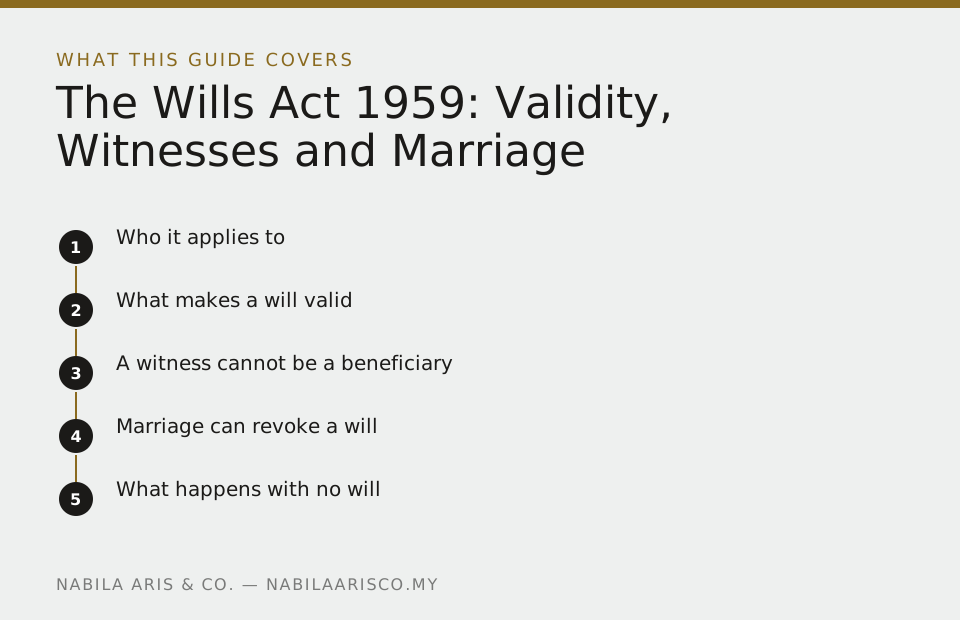
What this Wills Act 1959 guide covers
The Wills Act 1959 governs wills for non-Muslims in Peninsular Malaysia and Sarawak. That is the first thing to understand, because many people assume one law applies to everyone.
Who it applies to
The Act applies to non-Muslims. For Muslims, wills are governed by Islamic law and state enactments, and the rules differ fundamentally.
The clearest difference: for Muslims, a bequest to a non-heir is generally limited to one third of the estate unless the other heirs consent. Under the Wills Act 1959 there is no such limit.
Sabah has its own wills legislation, so the Peninsular position cannot be assumed to apply there.
What makes a will valid
- Age. The testator must have reached the age set out in the Act.
- In writing. An oral will is not valid under this Act.
- Signed by the testator, or by another person in the testator presence and at their direction.
- Two witnesses. Both present when the testator signs, and signing in the testator presence.
A witness cannot be a beneficiary
This is the most common and most costly mistake. If a witness or the spouse of a witness takes a benefit under the will, the gift to them fails.
The will itself remains valid. What fails is the share left to that witness. Families usually discover this after the death, when it is too late to correct.
Choose witnesses with no interest in the estate.
Marriage can revoke a will
Under this Act, marriage after a will is made can revoke that will, subject to certain exceptions.
The effect is significant. Someone who makes a will while single and later marries may die without a valid will without ever realising it. The estate is then distributed under the Distribution Act 1958 rather than according to their wishes.
Review a will after any major change: marriage, divorce, the birth of a child, or the purchase of a substantial property.
What happens with no will
For a non-Muslim who dies without a will, distribution follows a fixed formula in the Distribution Act 1958. The formula takes no account of your family circumstances, and the heirs must apply for letters of administration before any asset can be transferred.
That process is longer and more expensive than probate with a will.
A will alone does not transfer property
One misunderstanding worth clearing up: a will does not transfer title by itself. The executor still has to apply for a grant of probate at the High Court, and only then can the transfer be registered at the land office.
A will makes that process easier; it does not replace it.
Frequently asked questions about Wills Act 1959
Does the Wills Act 1959 apply to Muslims?
No. It applies to non-Muslims. Muslim wills are governed by Islamic law and state enactments, with fundamentally different rules.
Can my child witness my will?
They can, but if they take a benefit under it, their share fails. Choose witnesses with no interest in the estate.
I made a will before marrying, is it still valid?
Possibly not. Marriage after a will is made can revoke it, subject to certain exceptions. Review it after marrying.
Ready to start your property matter?
An initial consultation with no obligation. Tell us about your matter and we will explain what is involved and what it is likely to cost.
No 1, Jalan Setia Dagang AL U13/AL, Setia Alam, 40170 Shah Alam, Selangor
014-4004293 · Monday to Friday, 9:00am to 5:00pm