Subsale Conveyancing Lawyer for Sellers
We act for the seller in a subsale: discharging the existing charge, coordinating redemption with the bank, real property gains tax compliance, and delivery of title.

A conveyancing lawyer for sellers handles loan redemption, discharge of charge, the RPGT forms and handover of the title to the buyer. As a seller, your main costs are real property gains tax if you dispose of the property within a chargeable holding period, agent commission if any, and legal fees for the discharge of charge. Your lawyer also withholds a retention sum, 3% of the disposal price for a citizen seller, and remits it to the Inland Revenue Board within 60 days.
The conveyancing lawyer for sellers process step by step
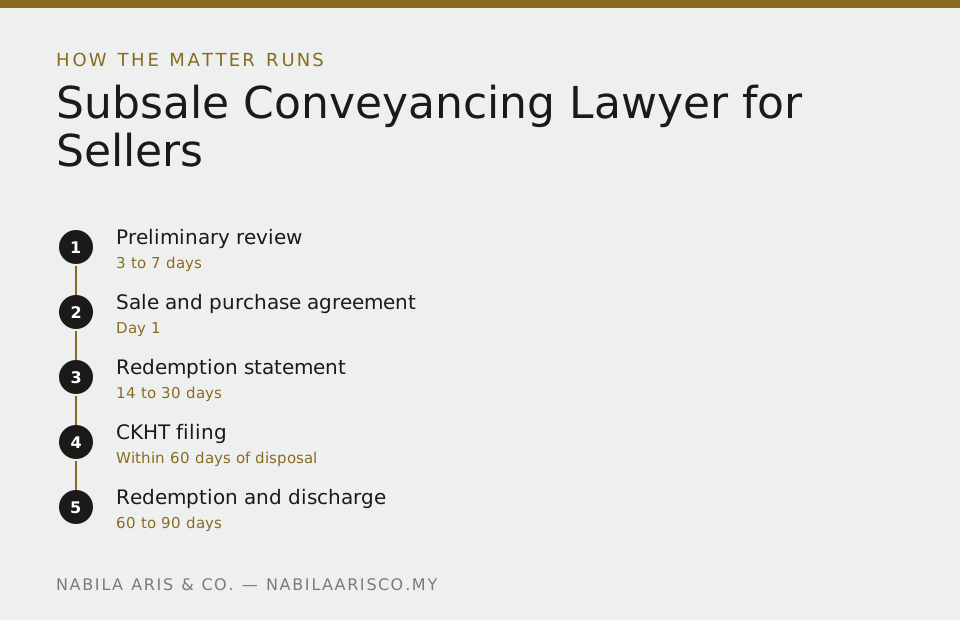
As a seller your matter is different from the buyer’s. The focus is not on checking title, but on three things: discharging the existing charge, meeting your real property gains tax obligations, and making sure you receive the balance proceeds with no liability left behind.
How a conveyancing lawyer for sellers handles the discharge
If your property is still charged to a bank, the title cannot be transferred until the loan is settled and the charge discharged. The first step is to request a redemption statement from the bank, showing the exact figure required to settle as at a given date.
That figure changes with the date, so the timing between the buyer’s payment, settlement of the loan, and discharge of the charge has to be coordinated carefully.
Real property gains tax for sellers
This tax is charged on the gain, not on the sale price. The gain is the disposal price less the acquisition price less allowable costs.
Allowable costs include the legal fees and stamp duty on your original purchase, agent commission, and renovation costs that enhance the value of the property. Receipts matter. Without them those costs are difficult to claim, and the tax payable ends up higher.
Joint ownership and what a conveyancing lawyer for sellers checks
Where a property is owned by more than one person, every registered proprietor has to sign. If one of them has died, that share has to be dealt with through estate administration before the sale can proceed. This is the most common cause of delay we see in sale matters.
How the money actually reaches a seller
As a seller you do not receive the price in one payment. The 10% deposit is held as stakeholder money until the conditions in the agreement are met. The balance comes from the buyer’s bank, and part of it goes straight to your bank to redeem your loan rather than to you.
If the property is still charged, ask your bank for the redemption statement early. That statement has an expiry date, and if it lapses before completion the process has to be repeated. It is one of the most common and most avoidable causes of delay.
For a non-resident seller, or for a disposal within a chargeable holding period, part of the price is held back as a retention sum until the tax forms are dealt with. Plan your cash flow on the basis that this money does not reach you on completion day.
A seller timeline, and where it stalls
Sellers often assume their part is done once they sign. It is not.
| Stage | Usual duration | Whose side it sits on |
|---|---|---|
| Requesting the redemption statement from your bank | 2 to 4 weeks | You, through your solicitor |
| Signing the sale and purchase agreement | 1 to 2 weeks | Both parties |
| Filing RPGT forms 1A and 2A | Within 60 days of disposal | Each side solicitor |
| Loan redemption and discharge of charge | 4 to 8 weeks | Your bank |
| Handover of title and balance payment | After the discharge is registered | Both solicitors |
The first and fourth rows both sit with your own bank. If you want the matter to move, ask your bank for the redemption statement on the day you agree to sell, not after the agreement is signed.
Documents you need to prepare
- Identity cards of every registered owner
- A copy of the title
- Current loan statement and the loan account number
- Recent quit rent and assessment receipts
- The original sale and purchase agreement from when you bought the property
- Receipts for legal fees and stamp duty on that original purchase, for RPGT deductions
- Receipts for improvement works that raised the value, for RPGT deductions
Four expensive seller mistakes
- Sharing a solicitor with the buyer to save money. In a smooth matter it looks like a saving. The problem appears when there is a dispute about the completion date, the condition of the property, or arrears. At that point one solicitor cannot advise two parties whose interests conflict, and you have to appoint a new one midway.
- Not keeping the original purchase receipts. Legal fees, stamp duty and improvement costs are all deductible in the RPGT computation. Without receipts the deduction is lost and the tax you pay is higher than it needed to be.
- Asking for the redemption statement late. This is the slowest stage in the whole matter and it depends entirely on your bank. Asking a week late can push handover back by a month.
- Signing before every registered owner has agreed. Where the title is in joint names, each owner has to sign. One owner abroad or unwilling can halt the whole matter after the deposit has been taken.
If the property is still in a deceased name
This comes up often and it is not something that can be sorted out alongside the sale.
A property cannot be sold in the name of someone who has died. The transfer to the beneficiaries has to be completed first, through a small estate, probate, or letters of administration, depending on the value of the estate and whether there is a will.
Documents a conveyancing lawyer for sellers needs early
A copy of the title, the loan redemption statement, current quit rent and assessment receipts, and for strata property, the maintenance account statement. If there are arrears they have to be cleared before the management body will issue its supporting letter for the transfer.
If the name on the title differs from your current identity card, deal with the correction before you put the property on the market. Fixing it mid-transaction means the buyer waits, and buyers who wait too long sometimes walk away.
If the registered owner has died, the property cannot be sold until the estate is resolved and the title is transferred to the beneficiaries. This is not a formality that can run in parallel with the sale.
What your lawyer handles
- Checking the outstanding loan and requesting a redemption statement from your bank
- Preparing or reviewing the sale and purchase agreement to keep the completion period realistic and your exposure narrow
- Attending to discharge of the charge once the sale proceeds clear the outstanding loan
- Calculating and withholding the retention sum for real property gains tax
- Preparing and filing Form CKHT 1A within 60 days of the disposal date
- Coordinating with the buyer's solicitors for delivery of title and the transfer instrument
- Splitting quit rent and assessment up to the handover date
- Remitting the balance sale proceeds to you after all deductions
Timeline
Documents you need to prepare
- Copy of the identity card of the seller and every registered proprietor
- Copy of the title
- Current loan statement from the bank
- The original sale and purchase agreement from when you bought the property
- Receipts for stamp duty and legal fees on the original purchase, as these are allowable costs in the tax calculation
- Receipts for major renovation work, if you wish to claim them as allowable costs
Costs people often overlook
- Real property gains tax, depending on the holding period and disposer category
- A retention sum of 3% of the disposal price for a citizen seller, or 7% for a non-citizen
- Legal fees for the discharge of charge
- Estate agent commission, if you sell through an agent
- Outstanding quit rent and assessment, which you settle before handover
- Early redemption charges from the bank, if your loan is still within a lock-in period
When to stop and get advice first
- Your outstanding loan exceeds the agreed sale price, so you must fund the difference in cash
- You own the property jointly and one registered proprietor is uncontactable, or will not sign
- One of the registered proprietors has died and nobody has administered the estate
- You cannot locate the receipts from the original purchase, which pushes the gains tax higher
- The buyer asks for a long completion period without clear compensation if it fails
Frequently asked questions about conveyancing lawyer for sellers
What is a retention sum?
It is part of the sale price withheld by the solicitors and remitted to the Inland Revenue Board towards real property gains tax. The rate is 3% for a citizen or Permanent Resident seller and 7% for a non-citizen. If the actual tax comes in lower, you get the excess back.
When is real property gains tax payable?
You must file Form CKHT 1A within 60 days of the disposal date. Your lawyer handles this filing alongside the sale.
After how many years is there no gains tax?
For citizens and Permanent Residents the rate falls to zero after the fifth year of holding. For non-citizens the rate remains at 10% with no time limit.
Can I deduct renovation costs in the tax calculation?
You can generally claim costs that enhance the value of the property, provided receipts back them up. Ordinary maintenance is not.
What if my outstanding loan exceeds the sale price?
You must fund the difference in cash before the land office will discharge the charge. Find this out early, not on the completion date.
Who pays the agent commission?
Normally the seller, subject to the agreement with the agent. The solicitors deduct it from the sale proceeds at completion.
How long before I receive the sale proceeds?
The balance normally comes to you after full completion, once the buyer pays the balance price, the proceeds settle the loan, and we make all deductions.
The property is in my name and my late husband's, can I sell?
Not until estate administration deals with his share. That must finish before the sale can proceed.
Ready to start your property matter?
An initial consultation with no obligation. Tell us about your matter and we will explain what is involved and what it is likely to cost.
No 1, Jalan Setia Dagang AL U13/AL, Setia Alam, 40170 Shah Alam, Selangor
014-4004293 · Monday to Friday, 9:00am to 5:00pm