Legal Fees and Stamp Duty for Property in Malaysia
Every cost in a Malaysian property matter: legal fees under the Solicitors Remuneration Order 2023, stamp duty, registration fees and disbursements. Every figure carries the law it is based on.
Updated 26 September 2026 · Written and reviewed by Nur Nabilah Binti Mohd Aris

Property legal fees in Malaysia are fixed by statute, not by the firm. For a subsale property at RM500,000 with a 90% loan, legal fees and stamp duty come to approximately RM26,075. That covers the sale and purchase agreement fee, the loan documentation fee, service tax of 8%, transfer stamp duty, loan agreement stamp duty, land office registration fees, and estimated disbursements.
What this property legal fees guide covers
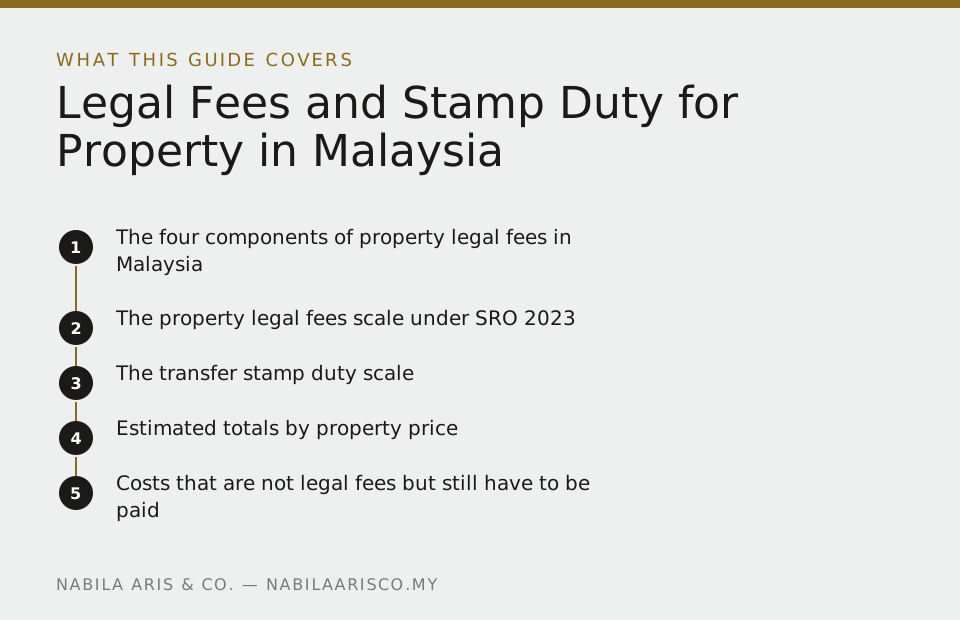
Legal costs in a Malaysian property transaction are not a price the firm sets. Conveyancing fees are fixed by statute under the Solicitors Remuneration Order 2023, and stamp duty is fixed under the Stamp Act 1949. The base figures are therefore the same whichever firm you appoint.
What differs between firms is disbursements, how the work is handled, and how well you are kept informed. This page breaks down each cost component, sets out the statutory scales, and points you to the guide for your specific type of matter.
The four components of property legal fees in Malaysia
What people call “legal costs” is really four separate things. Telling them apart matters, because three of the four never reach the lawyer.
- Legal fees. Payment for the lawyer’s work. Set by a tiered scale under the Solicitors Remuneration Order 2023, calculated on the property price. Where there is a loan, the loan documentation fee is calculated separately on the loan amount.
- Service tax. 8% on the legal fee only, not on stamp duty. This is a government tax the lawyer collects and remits.
- Stamp duty. Paid to the Inland Revenue Board. There are two: transfer duty on the instrument of transfer, and loan agreement duty if you take a loan.
- Registration fees and disbursements. Land office fees to register the transfer and the charge, official searches, bankruptcy searches, delivery and printing.
The property legal fees scale under SRO 2023
This scale applies twice in a financed purchase: once on the property price for the sale and purchase agreement and transfer, and again on the loan amount for the loan documentation. Each is calculated on its own amount.
| Value band | Rate |
|---|---|
| First RM500,000 | 1.25% |
| Next RM7,000,000 | 1.00% |
| Next RM7,000,000 | 0.70% |
| Next RM10,000,000 | 0.60% |
| Above RM25,000,000 | negotiable, not less than 0.50% |
The transfer stamp duty scale
Transfer stamp duty is calculated on the higher of the purchase price and the valuation by the Valuation and Property Services Department. If the valuation comes in above your purchase price, duty is assessed on the valuation.
| Value band | Rate |
|---|---|
| First RM100,000 | 1% |
| RM100,001 to RM500,000 | 2% |
| RM500,001 to RM1,000,000 | 3% |
| Above RM1,000,000 | 4% |
| Non-citizen buyer or foreign company, flat rate | 8% |
Estimated totals by property price
This table assumes a purchase with a bank loan at 90% margin, property in Selangor, and a citizen buyer who is not a first-time buyer.
| Property price | Legal fees | Stamp duty | Estimated total |
|---|---|---|---|
| RM250,000 | RM6,413 | RM5,125 | RM13,538 |
| RM500,000 | RM12,825 | RM11,250 | RM26,075 |
| RM750,000 | RM18,090 | RM19,875 | RM39,965 |
| RM1,000,000 | RM23,220 | RM28,500 | RM53,720 |
| RM1,500,000 | RM33,480 | RM50,750 | RM86,230 |
Costs that are not legal fees but still have to be paid
Several costs sit outside the breakdown above and are the ones buyers most often leave out of their budget:
- The deposit and earnest money to the seller, normally 10% of the purchase price inclusive of anything already paid to the agent
- Bank processing fees, MRTA or MLTA insurance, and a valuation fee where the bank charges one
- Utility deposits and account transfers for electricity, water and sewerage
- Maintenance charges and the sinking fund for strata property
- Quit rent and assessment, which have to be apportioned between seller and buyer
For a seller there is one further and often larger component: real property gains tax. The rate depends on the holding period and the disposer category.
| Holding period | Citizen & PR | Company | Non-citizen |
|---|---|---|---|
| Year one | 30% | 30% | 30% |
| Year two | 30% | 30% | 30% |
| Year three | 30% | 30% | 30% |
| Year four | 20% | 20% | 30% |
| Year five | 15% | 15% | 30% |
| Year six and beyond | 0% | 10% | 10% |
Cost guides by type of matter
Each type of matter has its own cost breakdown. Pick the one that matches your situation.
How to use these property legal fees figures
The figures on this page are indicative estimates for budgeting, not a quotation. The actual total depends on the valuation by the authorities, any exemption in force on the date of your transaction, the state where the property is registered, and whether your matter needs extra work such as State Authority consent or an estate that must be resolved first.
If you want a breakdown for your own case, our calculator takes the price, loan margin, buyer status and location, and returns a full breakdown with the law behind every line.
Why two quotes can differ on the same property
Conveyancing legal fees are fixed by statute, so that part should be identical. The difference usually comes from three places.
First, the assumed loan margin. One firm quotes on a 90% loan, another on 80%, and the loan documentation fee moves with it.
Second, whether disbursements are included. A quote showing only professional fees looks cheaper than one that includes searches, registration fees and delivery.
Third, whether service tax is shown. Tax is charged on the professional fee, and leaving it out of the display makes the total look lower than the actual bill.
How to read a quote properly
Ask for a breakdown that separates professional fees, service tax, stamp duty and disbursements. Those four lines make a real comparison possible.
Check as well whether the quote assumes a stamp duty exemption. If it does and you do not qualify, the real total will be very different.
Finally, ask what is excluded. Strata management body charges, developer consent fees and state authority consent fees are third-party costs that frequently do not appear in an initial quote.
Strata property carries one more possibility. Where the individual strata title has only just issued, a separate strata title transfer is needed to move the title into your name, and that is quoted separately from the original purchase.
Frequently asked questions about property legal fees
Are legal fees negotiable?
For conveyancing work within the Solicitors Remuneration Order 2023 scale, no. The fee is fixed by statute and a solicitor is not permitted to discount below the scale. Above RM25,000,000 the scale allows negotiation but not below 0.50%.
Why am I charged a legal fee twice?
You are not paying twice for the same work. One fee covers the sale and purchase agreement and the transfer, calculated on the property price. The other covers the loan documentation, calculated on the loan amount. They are two different sets of documents with two different parties.
When does stamp duty have to be paid?
Instruments must be stamped within the period prescribed after execution. The lawyer normally handles submission and payment as part of the matter. Late stamping can attract a penalty.
Is service tax charged on stamp duty?
No. The 8% service tax applies to the legal fee only. Stamp duty is a payment to the Inland Revenue Board and no service tax is charged on it.
Ready to start your property matter?
An initial consultation with no obligation. Tell us about your matter and we will explain what is involved and what it is likely to cost.
No 1, Jalan Setia Dagang AL U13/AL, Setia Alam, 40170 Shah Alam, Selangor
014-4004293 · Monday to Friday, 9:00am to 5:00pm