
Property guides by type of buyer organise the information around your situation rather than around document types. These property guides by type of buyer exist because the rules differ by who you are. The base costs and process are the same for every buyer, but exemptions, sources of funds and consent requirements differ. A first-time buyer may qualify for a stamp duty exemption. An LPPSA borrower follows a different documentation route from a bank. A Bumiputera lot needs consent before it can be transferred to a non-Bumiputera buyer.
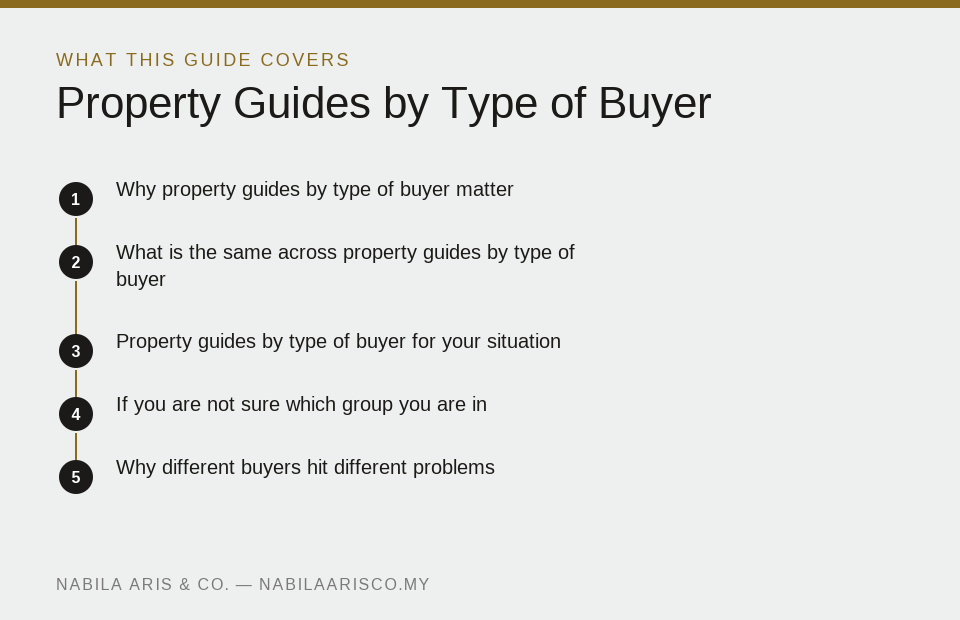
What this property guides by type of buyer guide covers
The fee scale and the stamp duty scale apply equally to everyone. What differs is the exemptions you qualify for, where your funds come from, and the additional consents your matter needs.
These differences are not minor. They can move the cost by thousands of ringgit and add weeks to the timeline. This page sets out what changes for each group.
Why property guides by type of buyer matter
Three things change depending on who you are:
- Exemptions. The first-time home buyer stamp duty exemption can cut the upfront cost substantially, but it carries a value cap and eligibility conditions that have to be checked as at the date of your transaction.
- Source of funds. A bank loan, an LPPSA loan, an EPF Account 2 withdrawal and a cash purchase each carry different documentation and timelines.
- Consents. Bumiputera lots, leasehold property and purchases by non-citizens require consents that take time and can be refused.
What is the same across property guides by type of buyer
Whichever group you fall into, some things do not change. The title search still has to be done. The deposit should still be held as stakeholder money rather than released straight to the seller. The transfer is still only effective once registered. And the legal fee still follows the same statutory scale.
Property guides by type of buyer for your situation
If you are not sure which group you are in
Some buyers fall into more than one category, such as a first-time buyer using an LPPSA loan who also withdraws from EPF Account 2. In that case the sequence matters: an EPF withdrawal has its own documentary requirements and has to be planned so the funds arrive before the completion date.
If you are unsure, send us a short summary. We can tell you which rules apply and what is different in your case.
Whichever group you fall into, the deposit should be held as stakeholder money rather than released straight to the seller, and a transfer is only effective once it is registered.
Why different buyers hit different problems
First-time buyers most often stumble on the sequencing of funds and on the stamp duty exemption forms. They have enough money, but at the wrong time.
Civil servants using LPPSA financing face an approval schedule that differs from a bank, and their problems almost always trace back to a completion period that was too short.
Investors face gains tax and ownership structure questions that are irrelevant to an owner-occupier.
Beneficiaries who inherit property face an entirely different route, because there is no sale at all until the estate is resolved.
If you fall into more than one group
Many people are in two groups at once: a first-time buyer using LPPSA financing, or an investor buying a property that is still in an estate.
In that case, start with the issue that most determines the timeline. If the property is still in an estate, that is the main issue. If the financing is through LPPSA, that decides the completion period.
Read the guides for both groups, then discuss the sequence with a solicitor before signing anything.
Documents to gather, and what changes by group
The core of the file is the same for everyone: identity card, payslips or proof of income, bank statements, EPF statement, tax documents, and a current official search on the property chosen.
First-time buyers add whatever supports the claim for the stamp duty exemption, since that exemption has to be claimed rather than applied automatically.
Public servants using a government housing facility add service documents and a legal quotation in the format the financing agency prescribes.
Self employed buyers add business registration documents and company accounts, and the income record usually has to cover a period that has already passed.
Buyers of restricted lots or leasehold property add the state consent application form. Beneficiaries inheriting property begin with estate documents rather than sale documents. Property legal costs sets out which cost items attach to each route.
The stages every buyer goes through
Groups differ, but the underlying sequence is the same, and knowing it makes it easier to see where your group departs from it.
The first stage is the title review before anything is signed. The second is the agreement and deposit, where the completion period begins.
The third stage is funding, and this is where bank lending, government financing and a cash purchase diverge most.
The fourth stage is stamping, and this is where a stamp duty exemption makes its difference.
The fifth stage is registration, and this is where state consent becomes the deciding factor on a restricted title. The property matter process works through each of those stages.
What delays each group most often
For first-time buyers, the usual causes are loan documents that are incomplete on first submission and a savings withdrawal application started late.
For public servants using government financing, the usual causes are a legal quotation that does not follow the prescribed format, and a completion period negotiated too tightly for the agency approval queue.
For buyers of restricted titles, the cause is the consent queue at the state office.
For beneficiaries, the cause is a registered proprietor who is still the deceased, because no sale can be registered until the estate is resolved.
For investors, the causes are usually ownership structure documents and the need to coordinate several matters at once.
I appointed them to handle my parents property matter and everything was handled smoothly and professionally. She explained everything clearly, was very patient with all of our questions and kept us updated throughout the process.
Athirah Azham · Google
Patient, takes the time to explain every term and procedure in detail, and has been very efficient in providing timely updates throughout the process. Whether you are purchasing a home for the first time or have been through the process before.
Aifa Azmi · Google
Excellent service throughout my property transfer transaction. The conveyancing team was professional, responsive, and efficient, keeping me informed at every stage.
Marina Mardi · Google
Rated 5.0 from 9 Google reviews.
Frequently asked questions about property guides by type of buyer
Can I use EPF and a bank loan together?
Yes, this is common. An EPF Account 2 withdrawal is often used towards the deposit or legal costs, with the balance financed by a bank loan. The key issue is timing: the EPF withdrawal has to be started early so the funds arrive before completion.
Is the first-time buyer exemption automatic?
No. It has to be claimed and is subject to eligibility conditions and a value cap in force on the date of your transaction. Confirm your eligibility before budgeting on the basis of the exemption.
Can a non-Bumiputera buy a Bumiputera lot?
A lot marked as a Bumiputera reserve on the title is subject to a restriction in interest. A transfer to a non-Bumiputera buyer requires State Authority consent and is not guaranteed to be approved.
Do investors pay different costs from owner-occupiers?
The fee and stamp duty scales are the same. What differs is that an investor generally does not qualify for the first-time buyer exemption, and has to account for real property gains tax on disposal.
Do legal fees change according to the type of buyer?
No. The scale for transfer and charge work is the same for everyone. What differs is the stamp duty exemption you qualify for and the additional consents your matter requires.
If I qualify for two reliefs, can I use both?
Each facility has its own conditions and is assessed separately. Check eligibility one at a time before setting a budget, because a wrong assumption here changes the whole cash calculation.
Which group should I follow if I fall into two?
Follow the one that governs the timeline. Estate matters and state consent come ahead of funding questions, because without those resolved nothing can be registered.
How do I confirm my route before signing?
Start with a title search and a list of your funding sources. If that combination is still unclear, contact our firm before any deposit is paid.
Ready to start your property matter?
An initial consultation with no obligation. Tell us about your matter and we will explain what is involved and what it is likely to cost.
No 1, Jalan Setia Dagang AL U13/AL, Setia Alam, 40170 Shah Alam, Selangor
014-4004293 · Monday to Friday, 9:00am to 5:00pm