Matrimonial Property Claims
Claims over property acquired during a marriage, whether after the death of a spouse or in the course of a divorce.

A matrimonial property claim is a claim over property acquired during the marriage. Harta sepencarian is a claim over property acquired during the marriage. For Muslims it is brought in the Syariah Court, and in an estate it is resolved before the balance is distributed under faraid.
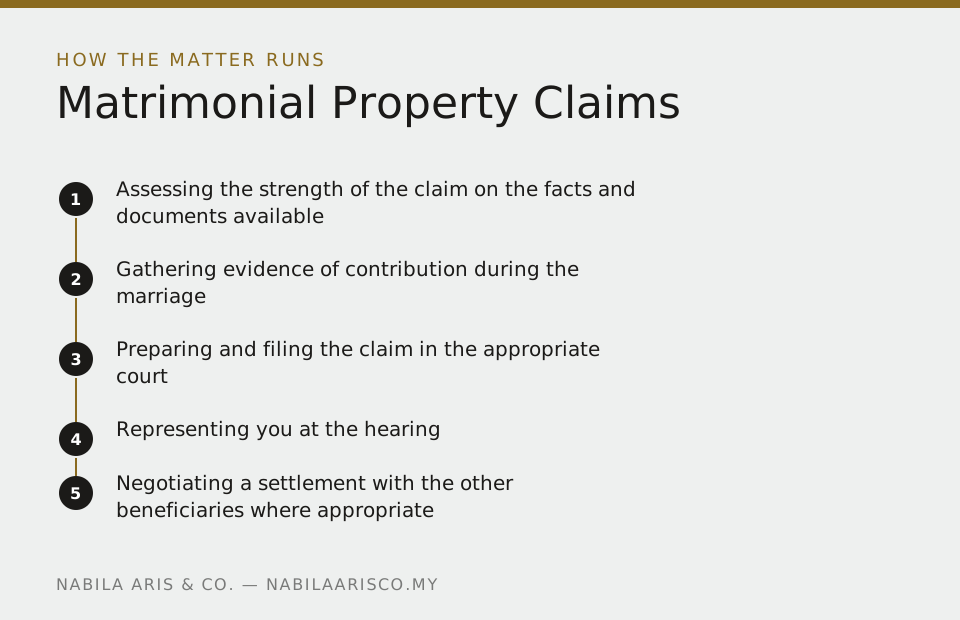
The matrimonial property claim process step by step
In many estate matters, the issue the family did not expect is not the faraid shares. It is a matrimonial property claim.
What is being claimed in a matrimonial property claim
Harta sepencarian refers to property acquired jointly during a marriage. For Muslims the claim goes to the Syariah Court, and it sits separately from the beneficiaries’ shares under faraid.
The name on the title is not the sole test. The court assesses contribution during the marriage, and contribution need not be financial.
The right order for a matrimonial property claim
In an estate, the matrimonial property claim comes first, and faraid governs only the balance. A successful claim comes out of the estate before anyone distributes the rest.
Starting the estate application without dealing with the claim forces you to reopen the distribution later, and that is far harder than taking it in order. A distribution that ignores a valid claim invites a challenge, and that costs more than dealing with it at the outset.
Tell the administrator or executor early that you intend to claim, so the distribution does not proceed on a wrong assumption.
Evidence that helps a matrimonial property claim
- Bank statements showing loan repayments
- Receipts and records of deposit or renovation payments
- EPF statements where a withdrawal went into the property
- Records of household expenditure over the relevant period
- Evidence of the role played in the family and in any family business
When a matrimonial property claim most often arises
Most often in a second marriage with beneficiaries from the first, and in families who bought the home during the marriage but put one name on the title.
It surfaces after a divorce, when the parties turn to dividing property. And after the death of a spouse, when the family opens the estate and finds one name on the title.
The name on the title is not decisive. The court looks at actual contribution across the marriage, not simply at whose name sits on the title.
If you are in this position, gather documents now even if you have not decided whether to claim. Bank records and receipts are far easier to obtain today than in a few years’ time.
The evidence a court considers
Contribution does not have to be financial. Running the household, raising children, and supporting a spouse’s business all count as contribution. Evidence is still needed, and written records are the strongest evidence.
Keep bank statements showing instalment payments, renovation receipts, and records of household spending. Where the contribution is non-financial, witness evidence and the pattern of daily life become the basis.
The length of the marriage and the length of the contribution also matter. The longer and more consistent the contribution, the stronger the claim.
What your lawyer handles
- Assessing the strength of the claim on the facts and documents available
- Gathering evidence of contribution during the marriage
- Preparing and filing the claim in the appropriate court
- Representing you at the hearing
- Negotiating a settlement with the other beneficiaries where appropriate
- Handling the transfer once you obtain an order
Documents you need to prepare
- Marriage certificate and death certificate where applicable
- Copy of identity card
- Copy of the title to the property claimed
- Evidence of contribution: bank statements, loan repayment receipts, EPF statements
- List of beneficiaries and their relationships
Costs people often overlook
- Legal fees for the claim and representation
- Court filing fees
- Search and document verification costs
- Service tax of 8% on legal fees
When to stop and get advice first
- Assuming one name on the title rules out a claim
- Waiting years, until evidence of contribution is hard to obtain
- Distributing the estate without resolving the claim
- A second marriage with beneficiaries from the first, and no planning
- An oral agreement among family with no proper determination
Frequently asked questions about matrimonial property claim
The property is in my husband's name only. Can I claim?
The name on the title is not the sole test. A matrimonial property claim looks at contribution during the marriage.
Does contribution have to be financial?
No. The court weighs other forms of contribution on the facts of each case.
If all the beneficiaries agree, is a court still needed?
Agreement helps, but you still need a proper determination so the land office can register the transfer without a later challenge.
How long does it take?
It depends on the court, and on whether anyone contests the claim. An agreed claim is generally faster.
Ready to start your property matter?
An initial consultation with no obligation. Tell us about your matter and we will explain what is involved and what it is likely to cost.
No 1, Jalan Setia Dagang AL U13/AL, Setia Alam, 40170 Shah Alam, Selangor
014-4004293 · Monday to Friday, 9:00am to 5:00pm