Lifetime Gifts Compared With Leaving an Estate
The difference between giving property during your lifetime and leaving it in your estate, and what has to be done for the gift to take effect.
Updated 8 November 2026 · Written and reviewed by Nur Nabilah Binti Mohd Aris

Gifting property before death only takes effect once the transfer is registered, unlike an estate distribution after death. A hibah is a gift made during the giver's lifetime. For it to take effect over land, the transfer must be registered. A gift document without registration does not move the title, and the property stays part of the estate.
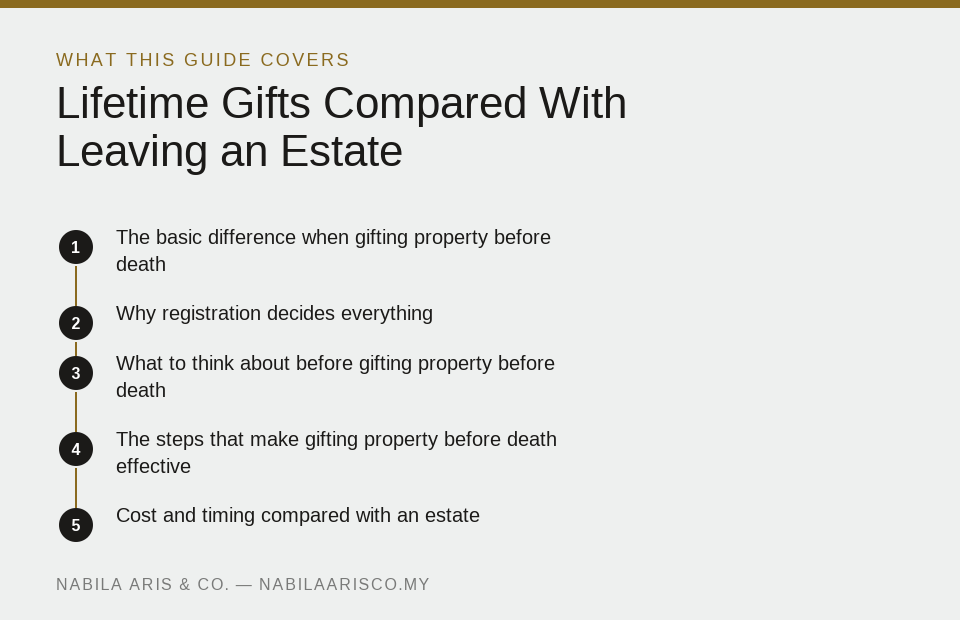
What this gifting property before death guide covers
Many families plan to give a home to a child during their lifetime so that there is no dispute after death. The intention is sound, but it only works if the registration step is completed.
The basic difference when gifting property before death
A hibah is a gift made while the giver is alive. An estate is what is distributed after death through whichever route applies. The practical difference is timing, and who carries the work.
Why registration decides everything
For land, ownership follows the register. Signing a gift document changes nothing on the register unless a transfer follows and the land office registers it.
That means when the giver dies, the property is still in their name and forms part of the estate, even though the family believed it had been given away. We see this, and it is difficult to unwind after a death.
What to think about before gifting property before death
- Whether the giver still needs the property for a home or for income
- The effect on other beneficiaries, particularly where only one child receives
- Whether the property is still charged, since the bank’s consent is needed
- Restrictions on the title requiring authority consent
- The stamp duty treatment that applies to transfers between close family
The steps that make gifting property before death effective
For land the steps are the same as any transfer: the gift document is prepared and signed, the transfer instrument is prepared, stamp duty is paid, any required consents are obtained, and the transfer is registered at the land office.
That last step is the decisive one. Without registration the title stays in the giver’s name and the property still falls into the estate on death.
If the property is charged, the bank’s consent is needed before registration. Settle that before the documents are drawn up, not after.
Giving a property to one child on a spoken understanding that the others will be looked after does not bind the registered owner. For land, the register decides, not what the family remembers.
Cost and timing compared with an estate
A lifetime gift carries transfer costs: legal fees, stamp duty after any relief that applies, and registration fees. Those costs are paid now.
An estate carries application costs after death, and the timeline depends on which route applies. Those costs are paid later, by the family.
The useful comparison is not only the total, but who pays and when. Some families choose a gift because it reduces the burden on beneficiaries at a time when they are grieving.
When a gift is not the right choice
If the giver still needs the property as a home or as a source of income, an outright gift may be premature.
If the property is still charged and the recipient cannot take over the loan, the gift cannot be perfected.
Where there are several children and only one receives, the effect on family relationships has to be thought through. A gift that is legally valid can still divide a family if it is not discussed.
The effect on other family members
A perfected gift takes the property out of the estate, so the other beneficiaries no longer have a share in it.
For Muslims, a gift made while the giver was gravely ill can be questioned. The giver’s state of health at the date of delivery becomes relevant.
Tell the family sooner rather than later. Gifts known about while the giver is alive rarely end in court.
Questions worth asking before deciding
Whether I still need this property as a home or as income.
Whether the recipient can take over the loan if the property is still charged.
What the effect is on other family members, and whether they have been told.
What the transfer costs now against the estate costs later.
Whether a will or another arrangement suits my aim better.
Documents to gather before the gift deed is drawn
Start with the original document of title. Where the bank holds it because the property is still charged, a letter from the bank is needed to release it.
A recent official land search shows the registered owner, any restriction in interest, any caveat, and any charge still on the register. The search surfaces obstacles before they become problems.
Identity documents for both the giver and the recipient are needed, and the spelling on each must match the name on the title.
Current quit rent and assessment receipts are needed because arrears have to be cleared before registration. For a strata property, the maintenance account statement is usually asked for as well.
What holds the registration up
An outstanding charge. While the bank holds a registered interest, the transfer cannot be registered without its consent or a discharge.
A restriction in interest on the title requiring state authority consent. That application is a separate stage and cannot be skipped.
A name on the title that does not match the identity card. Differences in spelling or an older name have to be corrected first through the title transfer process.
Quit rent arrears. The land office will not register a transfer while they remain unpaid.
A strata title not yet issued. A gift of a parcel without its own title has to be handled differently.
The mistakes we are most often asked to unpick
Signing the gift documents and then leaving them in a drawer. Without registration the property stays in the estate.
Treating a spoken gift in front of the family as enough. For land, the register decides, not what the family remembers.
Giving the property to one child on a spoken understanding that the others will be looked after. An understanding of that kind does not bind the registered owner.
Using a gift to avoid an estate matter, but only over part of the assets. Whatever is left still needs a full estate application.
Forgetting the effect on arrangements already in place. An older will that still names property already given away leaves the executor with a problem.
Common questions about gifting property before death
Can a gift be reversed once registered? After registration the recipient is the registered owner. Returning the property means another transfer, with its own costs and approvals.
Can the giver carry on living in the house? Yes, but that depends on the goodwill of the new owner unless a written arrangement is put in place.
Do all the children have to agree? A registered owner can give without the consent of other family members, though telling them reduces the risk of a dispute later.
Does a gift replace a will? No. A gift takes one asset out of the estate. Everything else still falls under a will or the intestacy rules.
I appointed them to handle my parents property matter and everything was handled smoothly and professionally. She explained everything clearly, was very patient with all of our questions and kept us updated throughout the process.
Athirah Azham · Google
Patient, takes the time to explain every term and procedure in detail, and has been very efficient in providing timely updates throughout the process. Whether you are purchasing a home for the first time or have been through the process before.
Aifa Azmi · Google
Excellent service throughout my property transfer transaction. The conveyancing team was professional, responsive, and efficient, keeping me informed at every stage.
Marina Mardi · Google
Rated 5.0 from 9 Google reviews.
Frequently asked questions about gifting property before death
The gift document is signed. Is that enough?
For land, no. Until the transfer is registered at the land office, the registered proprietor is still the giver, and the property remains part of the estate.
Can a gift be revoked?
That depends on the form of the gift and whether it has been perfected. Take specific advice rather than relying on an assumption.
Is stamp duty payable on a gift to a child?
Transfers between close family members by way of love and affection attract particular stamp duty treatment. Eligibility and the current rate should be confirmed at the time of the transaction.
Ready to start your property matter?
An initial consultation with no obligation. Tell us about your matter and we will explain what is involved and what it is likely to cost.
No 1, Jalan Setia Dagang AL U13/AL, Setia Alam, 40170 Shah Alam, Selangor
014-4004293 · Monday to Friday, 9:00am to 5:00pm