Grant of Probate
Applying for probate in the High Court to prove the will of the deceased and give the executor authority to carry out what it provides.

A grant of probate is a High Court order confirming a will and giving the named executor authority to act. Probate is a High Court order confirming the validity of a will and giving the named executor authority to carry it out. Without probate an executor has no authority to transfer property, release bank funds, or claim assets of the deceased.
The grant of probate process step by step
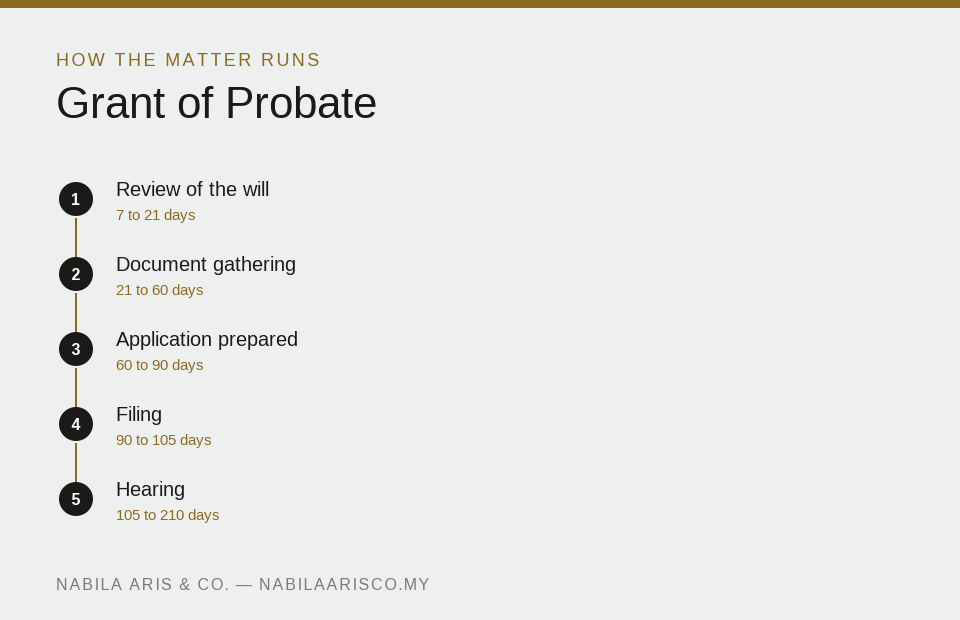
A valid will does not by itself give the executor authority to act. Banks, the land office and insurers require a court order before releasing assets. That order is probate.
What the court checks before a grant of probate
The court checks whether the will meets the legal requirements: that it was signed by the deceased, properly witnessed, and that the deceased had capacity to make a will at the time.
The original will is required. Where only a copy exists, the application becomes more complex and requires additional evidence about how the original was lost.
A grant of probate and a will under Islamic law
For Muslims, a will is limited to one third of the estate, and cannot be given to an heir who is entitled under faraid unless the other heirs consent. The remaining two thirds is distributed according to faraid.
This means a Muslim will operates as a complement to faraid, not a replacement for it. Misunderstanding this point is a frequent source of dispute after a death.
What the executor should prepare
The original will is needed, not a copy. If the original cannot be traced, the application becomes considerably harder and may require further evidence about how it was lost.
Prepare the death certificate, a list of the deceased’s assets and liabilities, and details of the beneficiaries named in the will. Banks will not release account information before the grant is obtained, so the initial list is usually built from documents found at home.
If one of the witnesses to the will has died or cannot be traced, tell the solicitor early, because it changes the evidence required.
A grant of probate needs the original will, not a copy. If the original cannot be traced, the application becomes considerably harder and may require further evidence about how it was lost.
When a will is challenged
The common challenges are that the deceased lacked mental capacity when signing, or that the will was made under undue influence. Either turns a probate application from an administrative matter into a contested one.
A challenge can also come from a family member left out of the will. For non-Muslims testamentary freedom is wide, but there are statutory provisions allowing certain dependants to apply for maintenance from the estate.
If you expect a dispute, gather supporting material early: medical records from around the date, the notes of the solicitor who prepared the will, and evidence that the deceased acted independently.
Working with the executor
Most of the work in a probate matter falls on the executor, and our job is to keep that work small. We take the original will, the death certificate and the asset list, and we draft the application papers around them. The executor signs, and we file and appear.
We also say at the start which parts cannot be delegated. An oath has to be sworn in person, and some banks insist on the executor attending once the grant issues. Everything else can run by correspondence.
Where the family is spread across several states or living abroad, we set the sequence so that each person signs once rather than twice. If you are unsure whether the will you hold is the latest one, speak to us before anything is filed.
How a probate application moves from file to grant
It begins with the will. We read it, confirm it was properly executed, and identify the executor named in it. If that executor has died or declines to act, the route changes before anything is filed.
Next comes the schedule of assets. Banks will not disclose balances before a grant, so the first schedule is built from papers found at home and corrected later.
The application and the supporting affidavit are then drafted, sworn and filed in the High Court. The court may raise queries, and each one has to be answered before the file moves on.
Once the grant issues, we use it to call in the assets and to register the transfer of any land into the names of the beneficiaries.
What a probate matter costs
Probate is court work rather than conveyancing, so the fee is not fixed by the Solicitors Remuneration Order in the way a transfer of property is. We quote on the size of the estate and on whether the application is likely to be contested.
The fee covers reading the will, drafting the application and the affidavit, filing, answering court queries and extracting the grant. It does not cover the later transfer of property into the names of the beneficiaries, which is separate conveyancing with its own fee under that order. Our legal fee calculator covers that second stage.
Court filing fees, the fee for swearing the oath and the cost of certified copies are disbursements, billed as incurred.
Where a probate application runs into trouble
The first obstacle is a will nobody can find. A grant needs the original, and a safe deposit box that opens only on production of a grant creates a circle that takes a further application to break.
The second is an incomplete asset list. An estate found to hold a further account or a further plot of land after the grant issues needs the grant amended.
The third is an executor who cannot act: deceased, unwilling, or out of contact. The application then has to be made by someone else, and the basis for that has to be set out.
The fourth is a beneficiary who disputes the will. Capacity and undue influence are both fact questions, and they turn a filing exercise into litigation.
I appointed them to handle my parents property matter and everything was handled smoothly and professionally. She explained everything clearly, was very patient with all of our questions and kept us updated throughout the process.
Athirah Azham · Google
Patient, takes the time to explain every term and procedure in detail, and has been very efficient in providing timely updates throughout the process. Whether you are purchasing a home for the first time or have been through the process before.
Aifa Azmi · Google
Excellent service throughout my property transfer transaction. The conveyancing team was professional, responsive, and efficient, keeping me informed at every stage.
Marina Mardi · Google
Rated 5.0 from 9 Google reviews.
What your lawyer handles in a grant of probate
- Checking the validity of the will in terms of form and execution
- Confirming the named executor and their willingness to act
- Preparing a schedule of the assets and liabilities of the deceased
- Preparing the affidavits and probate application documents
- Filing the application and appearing for the executor in court
- Attending to transfer of property under the will once the court grants probate
Timeline for a grant of probate
Documents to prepare for a grant of probate
- The original will
- Death certificate of the deceased
- Copy of the identity card of the deceased and the executor
- A complete schedule of the assets and liabilities of the deceased
- Details of the witnesses to the will, if the court needs attestation evidence
Costs people overlook in a grant of probate
- Legal fees for the application and court representation
- Court filing fees
- Cost of asset searches
- Land office fee for registration of the transfer after probate
- Service tax of 8% on legal fees
When to stop and get advice first
- Nobody can find the original will and only a copy survives
- The will was not signed or witnessed as the law requires
- There is more than one will bearing different dates
- The named executor has died or is unwilling to act
- A beneficiary challenges the validity of the will
- For a Muslim testator, the will gives more than one third of the estate to a non-heir without the consent of the heirs
Frequently asked questions about grant of probate
What is the difference between probate and letters of administration?
You apply for probate where a valid will names an executor. You apply for letters of administration where no will exists.
Does a will have to be registered to be valid?
A will does not need registration to be valid, but it must meet the legal requirements as to form, signature and witnesses.
I only have a copy of the will, can I apply for probate?
It gets harder, and the court needs extra evidence explaining how the original went missing. Discuss it with us as early as possible.
How long does probate take?
Usually four to nine months where there is no objection.
Can the executor sell property named in the will?
The executor's powers depend on the terms of the will and the grant issued. Check this before any dealing.
For Muslims, does a will override faraid?
Islamic law limits a will to one third of the estate, and an heir cannot take under it without the consent of the other heirs. Faraid governs the balance.
Can assets be released before the grant issues?
Generally no. Banks, insurers and the land office all want to see the grant. Some institutions release small sums on other evidence, but that is a concession rather than a right.
What if there is no will?
Then it is not probate. The route is a grant of letters of administration, or, where the estate includes land and falls within the limits set for that route, a small estate application.
How long does the court take?
That depends on whether queries are raised and how quickly the executor can answer them. A clean file with the original will and a complete schedule moves faster than anything else.
Ready to start your property matter?
An initial consultation with no obligation. Tell us about your matter and we will explain what is involved and what it is likely to cost.
No 1, Jalan Setia Dagang AL U13/AL, Setia Alam, 40170 Shah Alam, Selangor
014-4004293 · Monday to Friday, 9:00am to 5:00pm