Transfer Stamp Duty (MOT)
How transfer stamp duty is calculated under the Stamp Act 1949, the rates for citizens and non-citizens, and the exemptions that may apply.
Updated 8 September 2026 · Written and reviewed by Nur Nabilah Binti Mohd Aris

Transfer stamp duty is calculated in tiers on the market value or the purchase price, whichever is higher. Transfer stamp duty is calculated in tiers: 1% on the first RM100,000, 2% from RM100,001 to RM500,000, 3% from RM500,001 to RM1,000,000, and 4% on the balance above RM1,000,000. For a property at RM500,000 the duty is RM9,000. Non-citizen buyers and foreign companies pay a flat rate of 8%.
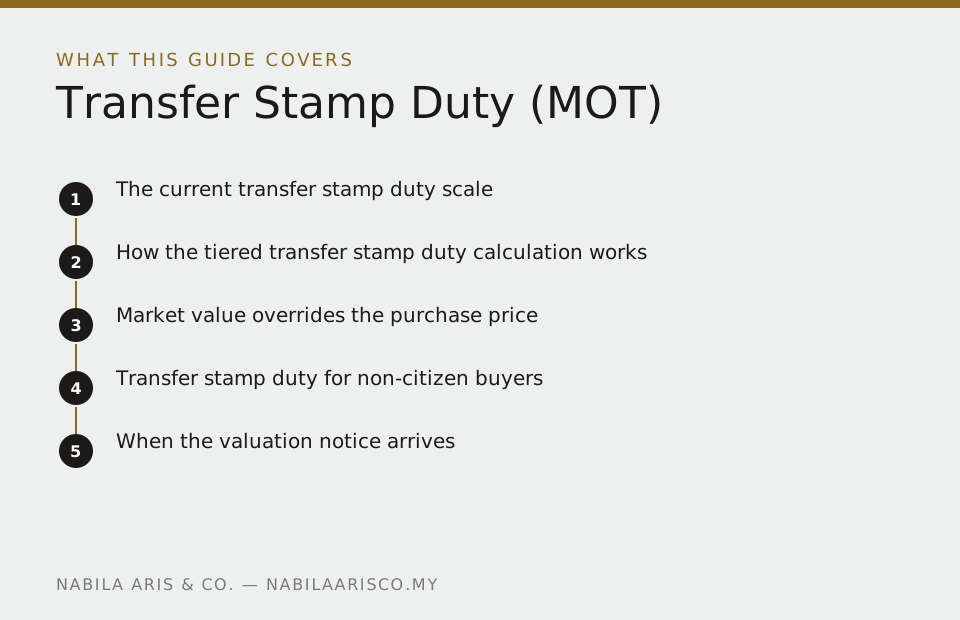
What this transfer stamp duty guide covers
Transfer stamp duty, often referred to as MOT, is the duty charged on the instrument transferring property. It is paid by the buyer and calculated in tiers.
The current transfer stamp duty scale
| Value band | Rate |
|---|---|
| First RM100,000 | 1% |
| RM100,001 to RM500,000 | 2% |
| RM500,001 to RM1,000,000 | 3% |
| Above RM1,000,000 | 4% |
| Non-citizen buyer or foreign company, flat rate | 8% |
How the tiered transfer stamp duty calculation works
The rates apply in tiers, not as a single rate on the whole price. For a property at RM500,000 the calculation is 1% on the first RM100,000 giving RM1,000, then 2% on the next RM400,000 giving RM8,000. The total is RM9,000.
For a property at RM800,000: 1% on RM100,000 giving RM1,000, 2% on RM400,000 giving RM8,000, and 3% on RM300,000 giving RM9,000. The total is RM18,000.
Market value overrides the purchase price
Stamp duty is charged on the market value or the purchase price, whichever is higher. This means that if you buy a property below market value, duty is still assessed on the valuation.
Valuation is carried out by the Valuation and Property Services Department, and it is a common reason why the final figure differs from an early estimate.
Transfer stamp duty for non-citizen buyers
From 1 January 2026, non-citizen buyers and foreign owned companies pay transfer stamp duty at a flat rate of 8%, up from 4%. The change was made by amendment to the Stamp Act 1949. See conveyancing for foreign buyers for the full process, including state consent and the minimum price.
Permanent Residents are not in this category and remain on the same tiered scale as citizens.
When the valuation notice arrives
Stamp duty is not paid on a figure you calculate for yourself. The transfer instrument is submitted to the stamp office, and an official valuation determines what is payable.
If the official valuation exceeds the purchase price, you pay on the valuation. This happens often on transfers between family members, and on properties in areas where prices rose after the agreement was signed.
Set money aside for that possibility. Buyers who budget stamp duty exactly on the purchase price are sometimes caught short when the notice arrives.
Exemptions and when they fall away
The first-time buyer stamp duty exemption depends on the price ceiling and on this being your first purchase. If you have owned residential property before, even if it has since been sold, the exemption may not apply.
The exemption also depends on the forms being filed correctly and in time. It is not granted automatically simply because you qualify.
On a joint purchase, the status of each buyer is taken into account. If one co-buyer has owned property before, that can affect eligibility for the whole purchase.
When the duty has to be paid
The transfer instrument has to be stamped within the prescribed period after execution. Late stamping attracts a penalty, calculated on the original duty.
In an ordinary matter the solicitor handles stamping as part of the process, so the period is rarely an issue. It becomes one in transactions run without a solicitor, or where documents sit unfiled for a long time.
The duty has to be settled before the transfer can be registered at the land office. It is not a cost that can be deferred until after you have the keys.
Which duty applies depends on the route the transfer takes. We set out the title transfer process, by reason, so you can match your situation to the right route.
Frequently asked questions about transfer stamp duty
Who pays transfer stamp duty?
The buyer. It is paid when the transfer instrument is stamped.
When is stamp duty payable?
Normally within the period prescribed after the instrument is executed. Late payment attracts a penalty.
Can the Inland Revenue Board value the property higher than the purchase price?
Yes. Stamp duty is charged on the market value or the purchase price, whichever is higher. Valuation is carried out by the Valuation and Property Services Department.
What is the rate for foreign buyers?
A flat rate of 8% applies to non-citizen buyers and foreign owned companies under Item 32(ab) of the Stamp Act 1949, as amended by the Finance Act 2025 and in force from 1 January 2026. The previous rate was 4%.
Are Permanent Residents charged 8%?
No. Permanent Residents remain on the tiered citizen scale.
How much is loan agreement stamp duty?
0.5% of the loan amount, separate from the transfer stamp duty.
Is there an exemption for first-time buyers?
There is an exemption for first-time buyers subject to a price cap and conditions in force. You need to check eligibility against your circumstances at the time of the transaction.
Ready to start your property matter?
An initial consultation with no obligation. Tell us about your matter and we will explain what is involved and what it is likely to cost.
No 1, Jalan Setia Dagang AL U13/AL, Setia Alam, 40170 Shah Alam, Selangor
014-4004293 · Monday to Friday, 9:00am to 5:00pm