Real Property Gains Tax (RPGT)
RPGT rates by holding period and disposer category, allowable costs, the retention sum, and the 60 day window for filing the CKHT forms.
Updated 4 October 2026 · Written and reviewed by Nur Nabilah Binti Mohd Aris

Real property gains tax is charged on the gain from disposing of a property, at a rate that depends on the holding period. Real property gains tax is charged on the gain, not on the sale price. For citizens and Permanent Residents the rate is 30% in the first three years, 20% in the fourth year, 15% in the fifth, and zero after that. For non-citizens the rate is 30% through to the fifth year and remains at 10% thereafter. The CKHT forms must be filed within 60 days of the disposal date.
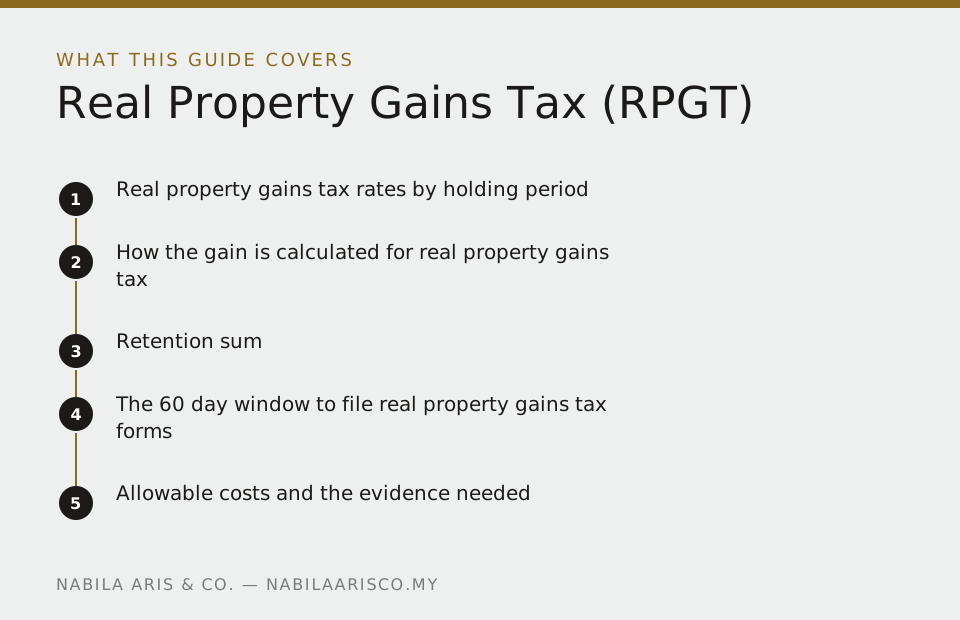
What this real property gains tax guide covers
Real property gains tax, known as RPGT or CKHT, is charged when property is disposed of at a price higher than the acquisition price. It is charged on the gain, not on the sale price.
Real property gains tax rates by holding period
| Holding period | Citizen & PR | Company | Non-citizen |
|---|---|---|---|
| First to third year | 30% | 30% | 30% |
| Fourth year | 20% | 20% | 30% |
| Fifth year | 15% | 15% | 30% |
| Sixth year onwards | 0% | 10% | 10% |
How the gain is calculated for real property gains tax
The chargeable gain is the disposal price less the acquisition price less allowable costs.
Allowable costs include the legal fees and stamp duty you paid when you bought the property, agent commission on the sale, and renovation costs that enhanced the value of the property. Ordinary maintenance does not count.
Every claim needs a receipt. That is the practical reason to keep purchase documents years after the matter closes. Without receipts those costs are difficult to claim and the tax payable ends up higher.
The retention sum and how it is released
The solicitors handling the sale are required to withhold part of the sale price and remit it to the Inland Revenue Board. The rate is 3% for citizen and Permanent Resident sellers, and 7% for non-citizens.
The amount withheld is not the actual tax. It is an advance payment, and the balance is released to the seller once the assessment is settled. The retention is one reason a seller needs their own solicitor rather than sharing the buyer’s. See subsale conveyancing for sellers.
If the actual tax is lower than the amount withheld, the excess is refunded, but the refund takes time.
A seller who needs the money quickly has to plan cash flow on the basis that this sum does not arrive on completion day.
The 60 day window to file real property gains tax forms
Form CKHT 1A by the seller and Form CKHT 2A by the buyer must be filed within 60 days of the disposal date. Late filing attracts a penalty.
The disposal date is normally the date of the sale and purchase agreement, not the date the keys change hands. This is frequently misunderstood and it is how the 60 day window gets missed.
Allowable costs and the evidence needed
The gain is computed after deducting allowable costs. These include acquisition costs such as stamp duty and legal fees on the purchase, and disposal costs such as agent commission and legal fees on the sale.
Renovation costs that add value to the property can also be deducted, but they need evidence. Contractor receipts, local authority approvals where relevant, and before and after photographs all help.
Ordinary maintenance such as repainting is not treated as value-adding. The line between maintenance and improvement is often disputed, so keep the documents from the start.
Questions worth asking
What the estimated tax is based on my acquisition and disposal dates.
Which costs are deductible, and what documents I need to prove them.
How much will be held as a retention sum, and when the balance is likely to come back.
What happens if I sell at a loss.
Whether any exemption applies to my situation.
Frequently asked questions about real property gains tax
Is RPGT charged on the sale price or the gain?
On the gain. The gain is the disposal price less the acquisition price less allowable costs.
What are allowable costs?
Costs connected with the acquisition and disposal, such as legal fees, stamp duty, agent commission, and renovation costs that enhance the value of the property. Receipts are required.
What is a retention sum?
Part of the sale price withheld by the solicitors and remitted to the Inland Revenue Board. The rate is 3% for citizen and Permanent Resident sellers, and 7% for non-citizens.
How long do I have to file the CKHT forms?
Within 60 days of the disposal date. Form CKHT 1A is filed by the seller and CKHT 2A by the buyer.
Is there a once in a lifetime exemption?
There is an exemption for the disposal of a private residence that can be claimed once in a lifetime, subject to conditions. It must be claimed, it is not given automatically.
What if I make a loss?
If there is no gain, no RPGT is charged. The forms still have to be filed, and the retention sum withheld is refunded after assessment.
Do non-citizens ever reach zero?
No. For non-citizens the minimum rate remains at 10% regardless of how long the property has been held.
Ready to start your property matter?
An initial consultation with no obligation. Tell us about your matter and we will explain what is involved and what it is likely to cost.
No 1, Jalan Setia Dagang AL U13/AL, Setia Alam, 40170 Shah Alam, Selangor
014-4004293 · Monday to Friday, 9:00am to 5:00pm