
Hidden costs buying property are the payments that sit outside the purchase price and the headline legal fees. Beyond the deposit, legal fees and stamp duty, a buyer needs funds for disbursements, land office registration fees, 8% service tax, utility deposits, maintenance charges for strata property, and apportionment of quit rent and assessment. Together these can run to several thousand ringgit outside the original estimate.
What this hidden costs buying property guide covers
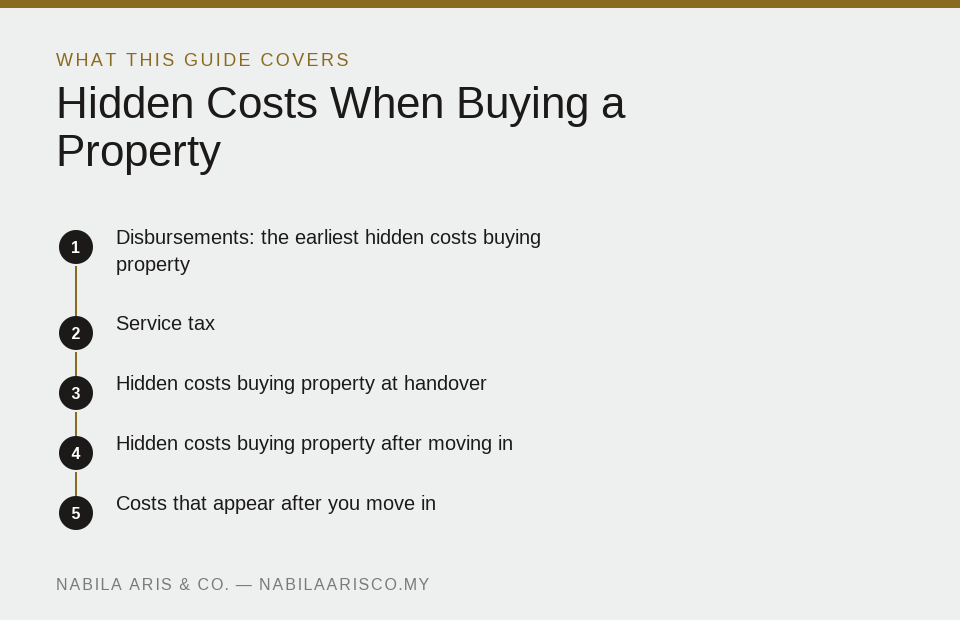
Most buyers plan for the deposit and the legal fees. What gets missed are the smaller costs, which are numerous, and which add up to several thousand ringgit.
Disbursements: the earliest hidden costs buying property
These are actual costs paid out on your behalf, separate from legal fees. They include official land searches, a bankruptcy search on the seller, land office fees for registering the transfer and the charge, delivery of documents, printing and copies.
As a reference, the land office fee for registering a transfer in Selangor is RM400 and for registering a charge RM100. Total disbursements are usually between RM800 and RM1,500 for an ordinary residential transaction.
Service tax
Service tax of 8% applies to legal fees since 1 March 2024. For a transaction with combined legal fees of RM12,000, that is an additional RM960.
Financing covers the purchase price up to the approved margin, not the cost of the transaction itself. Stamp duty, legal fees and disbursements come out of your own savings.
Hidden costs buying property at handover
For strata property, maintenance charges and a contribution to the sinking fund normally have to be settled before keys are handed over. Utility deposits for electricity and water also need to be provided.
Quit rent and assessment are apportioned at the handover date. If the seller has paid for a period extending past handover, the buyer reimburses their share.
Hidden costs buying property after moving in
For a subsale property, renovation, cleaning and changing the locks are things rarely included in the initial budget. They are not legal costs, but they are part of the real cost of moving in.
Costs that appear after you move in
Assessment and quit rent start in the year you become the owner, and some buyers forget to include them in the first year’s budget.
For strata property, maintenance charges and the sinking fund are billed monthly. Rates differ by project and unit size, and a special levy can be raised when major works are approved at a general meeting.
Fire insurance is required by the bank throughout the loan. For strata property the building insurance is usually handled by the management body, but contents insurance remains your responsibility.
How to budget so you are not caught short
Split the money into three parts. First, the deposit and the costs at signing. Second, stamp duty and legal fees payable before registration. Third, the costs after handover such as renovation, furniture and the first utility bills.
Do not put every ringgit of savings into the deposit. Buyers who exhaust their savings at the first stage often end up borrowing at a higher rate to pay stamp duty a few months later.
Use the fee calculator on this site for an estimate, then add a margin for the possibility that the valuation comes in above the purchase price.
Where costs differ between subsale and a developer purchase
On a developer purchase some costs are absorbed into the package offered and some are not. Read what the package actually covers before setting a budget.
On a subsale nearly every cost falls on the buyer separately, so the estimate has to be more detailed.
For both, progressive release of funds and interest during construction are the items first-time buyers most often leave out of the calculation.
Questions worth asking before signing
The full list of costs from today until the day I get the keys.
Which costs fall at signing, and which a few weeks later.
Whether the estimate assumes a stamp duty exemption, and whether I qualify.
What costs arrive after I move in, such as maintenance charges and assessment.
How much margin to set aside in case the valuation comes in higher.
When each cost falls due across the purchase
Before anything is signed, the costs are small but real. Preliminary searches and a title check happen at this point, and they are payable even if the purchase later falls through.
On the day of signing, the deposit and part of the professional fee are called for together. Many buyers set aside money for the deposit alone and are caught by the second half.
A few weeks later, stamp duty on the transfer and on the financing documents falls due. This is the heaviest point in the cash flow of a purchase.
At registration and handover, land office fees, outstanding maintenance charges, utility deposits and fitting out costs appear. Each is modest on its own and heavy once added together.
The documents that reveal these costs before you sign
A copy of the title shows restrictions in interest, caveats and any existing charge. Each of those adds a step, and every added step carries a cost.
The maintenance account statement and the letter from the management body show arrears. Arrears have to be cleared before the supporting letter is issued, and without that letter the transfer stalls.
Quit rent and assessment receipts show whether anything outstanding is holding back registration.
The letter of offer from the bank shows the actual margin, and the margin determines the cost of the financing documents. Ask for all of these before signing rather than after.
Budget assumptions that most often go wrong
The first is treating the deposit as the largest cash item. For most buyers, stamp duty and legal fees together exceed what was set aside at the deposit stage.
The second is assuming the loan covers everything. Financing covers the purchase price up to the approved margin, not the cost of the transaction itself. Those costs come out of savings.
The third is reading a quotation as a final figure. Disbursements are charged at actual cost and move with the condition of the property and the number of searches that have to be repeated.
The fourth is assuming costs end when the keys are handed over. Work through your figures in the legal fee calculator before you commit to a timeline.
I appointed them to handle my parents property matter and everything was handled smoothly and professionally. She explained everything clearly, was very patient with all of our questions and kept us updated throughout the process.
Athirah Azham · Google
Patient, takes the time to explain every term and procedure in detail, and has been very efficient in providing timely updates throughout the process. Whether you are purchasing a home for the first time or have been through the process before.
Aifa Azmi · Google
Excellent service throughout my property transfer transaction. The conveyancing team was professional, responsive, and efficient, keeping me informed at every stage.
Marina Mardi · Google
Rated 5.0 from 9 Google reviews.
Frequently asked questions about hidden costs buying property
What is the difference between legal fees and disbursements?
Legal fees are the charge for legal work, fixed by statute. Disbursements are actual costs paid out on your behalf, such as official searches and registration fees.
How much are utility deposits?
They vary by utility provider and property type. For strata property, deposits and maintenance charges normally have to be settled before keys are handed over.
What is apportionment of quit rent and assessment?
Quit rent and assessment are paid for a period. At handover they are apportioned so the seller bears their share and the buyer bears the balance.
When are all these payable?
Most legal fees and stamp duty are paid early, after the sale and purchase agreement. Utility deposits and maintenance charges are normally due at handover.
Can these costs be included in the loan?
Some banks allow additional financing for legal fees and stamp duty. It depends on the approved margin and the bank's policy.
Are these costs really hidden?
Not in any legal sense. They are simply absent from listings and from monthly instalment calculations, so buyers meet them late.
Can I ask for a full list before signing?
Yes, and you should. Ask for a breakdown by payee and by stage rather than a single total.
Which is heavier, a subsale or a developer purchase?
The order in which costs arrive differs. The components are compared in the guide to property legal costs.
How much margin should I keep aside?
Keep a reserve for a stamp duty assessment above the purchase price and for repeat searches. For a check on a specific property, send the details through the contact page.
Ready to start your property matter?
An initial consultation with no obligation. Tell us about your matter and we will explain what is involved and what it is likely to cost.
No 1, Jalan Setia Dagang AL U13/AL, Setia Alam, 40170 Shah Alam, Selangor
014-4004293 · Monday to Friday, 9:00am to 5:00pm