
Refinancing costs cover legal fees for loan documentation under the Solicitors Remuneration Order 2023, stamp duty on the new loan agreement, land office registration fees for both the discharge of the old charge and the new charge, and official searches. Refinancing involves two registration matters running at once, not merely an exchange of documents between banks. Check the lock-in period on the existing loan and whether the title has been perfected in your name.
What this refinancing costs guide covers
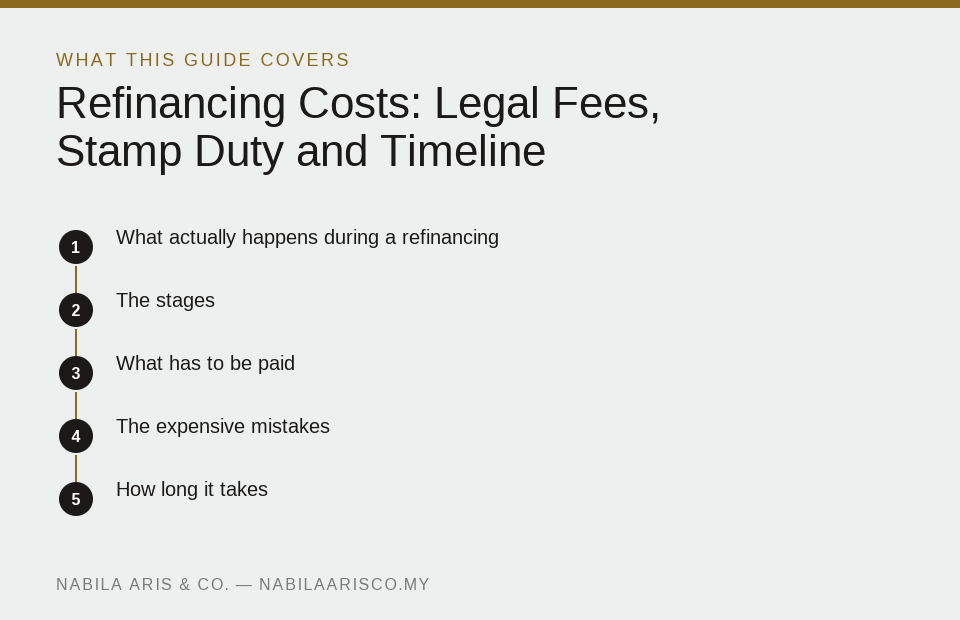
Refinancing is not a sale, but from the land registry point of view it involves almost all the same steps. Owners are often surprised by the cost, because they assume switching banks is a matter between them and the banks alone.
What actually happens during a refinancing
The existing bank holds a registered charge over your title. The new bank will not release funds until it is satisfied that the old charge will be discharged and its own charge can be registered in its place.
So two matters run in parallel: discharge of the existing charge, and registration of the new one. Both are registration matters at the land office, not merely an exchange of documents between banks.
The stages and where refinancing costs fall
- Redemption statement. The existing bank issues a settlement figure valid to a stated date. The figure changes if that date is missed.
- Official title search. To confirm the registered owner, the existing charge, and any caveat or restriction that could block the matter.
- New loan documents. The loan agreement and charge are prepared, executed and stamped.
- Release and settlement. The new bank releases funds directly to the existing bank.
- Discharge and registration. The discharge from the old bank and the new charge are registered at the land office.
Refinancing costs: what has to be paid
Legal fees for loan documentation are calculated under the Solicitors Remuneration Order 2023 on the new loan amount. They are the same at any firm.
Beyond that there is stamp duty on the new loan agreement, land office registration fees for both the discharge and the new charge, official search costs, and other disbursements.
One point worth checking: from time to time the government issues stamp duty exemption orders covering refinancing in defined circumstances. They are not automatic and the conditions change. Ask whether any exemption applies to your case before assuming the full cost.
Stamp duty exemptions for refinancing are not automatic and the conditions change from time to time. Ask whether any exemption applies to your case before assuming the full cost.
The most expensive mistakes on refinancing costs
Counting the monthly saving alone without the registration costs. If the interest saving is RM150 a month but the refinancing costs several thousand, the break-even period may be longer than you intend to hold the property.
Another: the lock-in period on the existing loan. Many banks impose a penalty if the loan is settled within a set period. Check the original agreement before starting anything.
And the one we see most often: the title is still in the developer name because perfection of transfer was never done. A refinancing cannot proceed until that is resolved first.
How long it takes
For a straightforward matter, two to three months from execution to completed registration. Where the title has to be perfected first, or where a caveat or restriction in interest exists, that period extends.
What falls due and when in a refinancing
Before the application, the new bank needs a valuation. The valuation is paid for by the borrower and remains payable even if the application is not taken further.
Once the offer is accepted, the solicitors prepare the new financing documents. Stamp duty on those documents has to be settled before they can be completed.
At the same time the existing charge has to be discharged. That needs a redemption statement from the original bank and carries its own documentation and registration cost.
At the final stage the new charge is registered and the balance of the professional fee and disbursements is settled. Funds are released only after registration, so these costs fall due before you see any monthly saving at all.
What the new bank will ask for
A copy of the title and identification documents for the borrower are the starting point. The spelling of names has to match the title, because a difference forces a further statutory declaration.
A redemption statement from the original bank is needed to establish the exact balance and the date to which it is valid. An expired statement has to be requested again and delays completion.
A valuation report is needed before the margin is fixed, because the margin depends on current value rather than on the price you paid.
For strata property, a letter from the management body and a maintenance statement are needed. For leasehold property, the unexpired term is checked because it affects the tenure offered.
The costliest miscalculations on refinancing costs
The first is comparing interest rates alone without counting the cost of moving. A monthly saving only means something once legal fees, stamp duty and the valuation are set against it.
The second is forgetting the early settlement penalty on the existing facility. That penalty is governed by your original agreement and has nothing to do with the law firm.
The third is calculating the fee on the outstanding balance of the old loan. The documentation fee is calculated on the new financing amount, which is usually higher where cash is being taken out.
The fourth is assuming these costs differ between firms. The charge documentation fee follows a set scale, as explained in the guide to loan agreement legal fees.
Who is paid for what in a refinancing
The professional fee goes to the firm preparing the new financing documents and handling the discharge of the old charge.
Stamp duty goes to the stamp authority through the solicitors. The firm administers that payment rather than receiving it.
Search fees, the discharge fee and the registration fee go to the land office. The valuation is paid to a registered valuer, and any early settlement penalty is paid to the original bank.
Because the money goes to several different recipients, a single line quotation is hard to check. Ask for a breakdown by payee, then confirm the legal fee portion in the legal fee calculator.
I appointed them to handle my parents property matter and everything was handled smoothly and professionally. She explained everything clearly, was very patient with all of our questions and kept us updated throughout the process.
Athirah Azham · Google
Patient, takes the time to explain every term and procedure in detail, and has been very efficient in providing timely updates throughout the process. Whether you are purchasing a home for the first time or have been through the process before.
Aifa Azmi · Google
Excellent service throughout my property transfer transaction. The conveyancing team was professional, responsive, and efficient, keeping me informed at every stage.
Marina Mardi · Google
Rated 5.0 from 9 Google reviews.
Frequently asked questions about refinancing costs
How long does a refinancing take?
For a straightforward matter, two to three months from execution to completed registration. It extends where the title must be perfected first or a caveat sits on the title.
Is there a stamp duty exemption for refinancing?
The government issues exemption orders for defined circumstances from time to time. They are not automatic and the conditions change, so check what is in force on the date of your matter.
The title is still in the developer name, can I refinance?
Not until the perfection of transfer is completed. The new bank cannot register a charge over a title that is not in your name.
Can the legal costs be included in the new facility?
Some banks allow it and some do not. Where it is allowed, the cost becomes part of the financing and is repaid over the tenure, so it is deferred rather than saved.
Do I have to use the same firm that acted on the purchase?
No. The new bank appoints solicitors for the financing documents, and that firm need not be the one that handled the original purchase.
Why is a valuation needed again on the same property?
Because the new margin depends on current value. The value at the date of purchase is not used.
What happens if the application is declined after the valuation?
The valuation and any searches already incurred are not refunded, and work already carried out remains chargeable according to the stage reached.
How early should I start?
Start before the lock in period on the existing facility expires, so the early settlement penalty does not swallow the saving. Send the property details and the outstanding balance through the contact page for an early review.
Ready to start your property matter?
An initial consultation with no obligation. Tell us about your matter and we will explain what is involved and what it is likely to cost.
No 1, Jalan Setia Dagang AL U13/AL, Setia Alam, 40170 Shah Alam, Selangor
014-4004293 · Monday to Friday, 9:00am to 5:00pm