Tenancy Agreement Stamp Duty: Rates and Worked Examples
How tenancy agreement stamp duty is calculated under the Stamp Act 1949, the rates by lease term, and worked examples for common monthly rents.
Updated 13 November 2026 · Written and reviewed by Nur Nabilah Binti Mohd Aris

Tenancy agreement stamp duty is calculated on the annual rent, for every RM250 or part of it, and the rate depends on the length of the term. The rate is RM1 for a term not exceeding one year, RM3 for over one year up to three years, RM5 for over three years up to five years, and RM7 for over five years. The exemption for annual rent of RM2,400 or less was removed with effect from 1 January 2025. For rent of RM1,500 a month over one year, the stamp duty is RM72.
What this tenancy agreement stamp duty guide covers
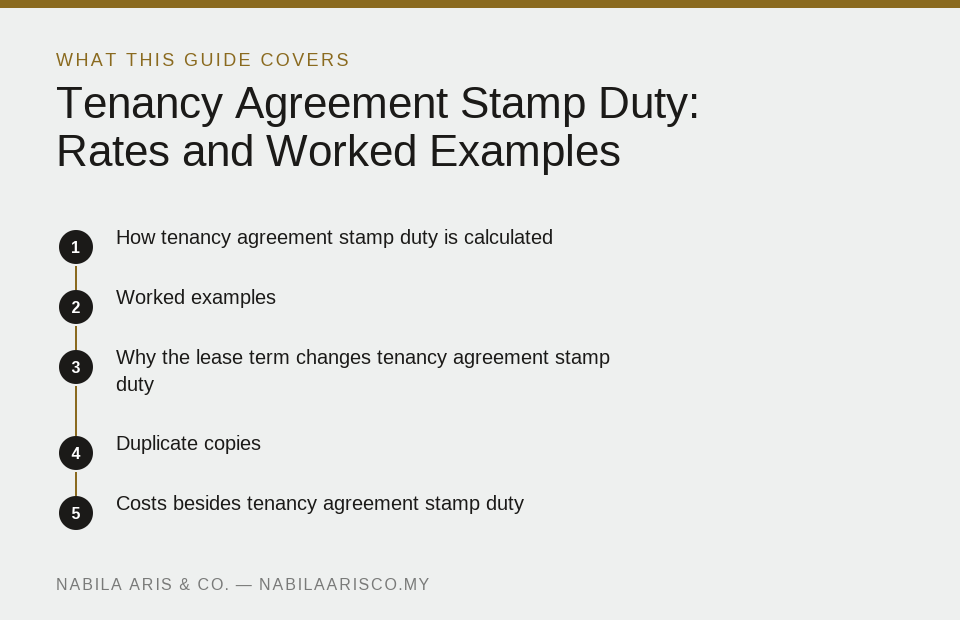
Tenancy agreement stamp duty is far smaller than transfer stamp duty, but it is often misunderstood. It is not a percentage of the rent. The official rates are set out in the LHDN stamp duty guideline. It is calculated in blocks of RM250, on the annual rent, and the rate depends on the length of the term.
How tenancy agreement stamp duty is calculated
The formula has two steps. Take the monthly rent and multiply by twelve to get the annual rent. Divide that figure into blocks of RM250, and each block or part of a block is charged at the rate for the lease term.
The exemption for annual rent of RM2,400 or less has been removed. It applied before 1 January 2025. Older articles that still mention the exemption are out of date.
| Lease term | Duty per RM250 of annual rent |
|---|---|
| Term not exceeding 1 year | RM1 |
| Term exceeding 1 year up to 3 years | RM3 |
| Term exceeding 3 years up to 5 years | RM5 |
| Term exceeding 5 years or for an indefinite period | RM7 |
Worked examples
The table below shows the stamp duty for common monthly rents, by length of the agreement.
| Monthly rent | 1 year | 2 years | Over 3 years |
|---|---|---|---|
| RM800 | RM39 | RM117 | RM195 |
| RM1,200 | RM58 | RM174 | RM290 |
| RM1,500 | RM72 | RM216 | RM360 |
| RM2,000 | RM96 | RM288 | RM480 |
| RM3,000 | RM144 | RM432 | RM720 |
| RM5,000 | RM240 | RM720 | RM1,200 |
Take rent of RM1,500 a month for a one-year term. The annual rent is RM18,000. Divided by RM250 that gives 72 blocks. At RM1 per block, the stamp duty is RM72. On the same rent over a three-year term the RM3 rate applies, so the stamp duty becomes RM216.

Why the lease term changes tenancy agreement stamp duty
The rate triples once the term exceeds one year, rises fivefold once it exceeds three years, and sevenfold once it exceeds five years. A three-year tenancy at the same rent carries three times the stamp duty of a one-year agreement. This is worth factoring in when deciding the term, though the amounts remain small relative to other costs.
An unstamped tenancy agreement is not void, but it cannot be admitted in evidence in court until the duty and the penalty are paid, and that penalty often far exceeds the original duty.
Duplicate copies
A tenancy agreement is normally stamped in one original, with a duplicate for the other party. The duplicate carries a small nominal duty. Your lawyer will handle the stamping of both.
Costs besides tenancy agreement stamp duty
Stamp duty is not the only cost in a tenancy:
- Legal fees for preparing or reviewing the tenancy agreement
- Rental deposit and utility deposit paid to the landlord
- Agency administrative charges, where an agent is involved
- The cost of stamping the duplicate copy
Why a tenancy agreement should be stamped
An agreement that is not duly stamped may not be admissible in evidence in civil proceedings until the duty and any penalty are paid. For a landlord who may need to enforce the terms, this matters. The cost of stamping is small against the risk of being unable to rely on your own document.
Commercial leases
Commercial leases follow the same calculation principles, but the terms are usually more complex: renewal clauses, scheduled rent increases, maintenance responsibilities, and permitted use of the premises. The legal cost for a commercial lease reflects that more detailed drafting work.
Why an unstamped agreement becomes a problem
An unstamped tenancy agreement is not void, but it cannot be admitted in evidence in court until the duty and the penalty are paid.
That means a landlord who wants to recover rent arrears has to stamp it first, with a penalty, before the case can go forward. That penalty often far exceeds the original duty.
Tenants are affected too. An unstamped agreement makes it harder for a tenant to prove the terms that were agreed when a dispute arises.
What changes the amount of duty
The two main factors are the annual rent and the term. A three-year agreement attracts a different rate from a one-year agreement at the same monthly rent.
Duplicate copies attract a small fixed duty, and this is often overlooked when both parties want a stamped copy to keep.
For commercial leases the structure can be more complex because payments beyond the base rent are sometimes involved. Check what counts as rent for duty purposes before calculating.
When tenancy stamp duty has to be settled
During negotiation no duty arises. What happens at that point is that the rent and the term are agreed, and both of those determine the duty later.
Once the agreement is signed, it goes for stamping. Stamping follows signing rather than preceding it, because the duty is calculated on the finalised terms.
The duty has to be paid within the period set under the Stamp Act. Late stamping attracts an additional charge, and that charge is not waived because the matter was overlooked.
After stamping, the stamped original goes to whichever party holds it. Rental and utility deposits are dealt with under the agreement itself and have nothing to do with the duty.
The particulars and documents needed before stamping
A complete agreement signed by both parties is needed. An unsigned agreement cannot be stamped.
The particulars of the premises have to be exact, including the full address and the unit reference. Particulars that do not match the title cause problems if the agreement has to be relied on later.
Identification documents for the landlord and the tenant are needed, with consistent spelling of names. Where the tenant is a company, incorporation documents and evidence of the authority of the signatory are needed.
The rent schedule and the term have to be stated clearly, including any option to renew. An option that is not properly expressed can change how the agreement is read.
Mistakes that come up on tenancy agreements
The first is leaving the stamping until a dispute arises. By then the late charge has accrued and the agreement is the very document being relied on.
The second is stating the term loosely. The term determines the amount of duty, so an unclear term produces an assessment nobody expected.
The third is forgetting duplicate copies. Each copy to be held as a document of equal standing carries duty of its own.
The fourth is confusing the duty with the fee for preparing the agreement. The preparation fee goes to the firm that drafts the document, while the duty goes to the stamp authority. Similar splits are set out in the guide to property legal costs.
I appointed them to handle my parents property matter and everything was handled smoothly and professionally. She explained everything clearly, was very patient with all of our questions and kept us updated throughout the process.
Athirah Azham · Google
Patient, takes the time to explain every term and procedure in detail, and has been very efficient in providing timely updates throughout the process. Whether you are purchasing a home for the first time or have been through the process before.
Aifa Azmi · Google
Excellent service throughout my property transfer transaction. The conveyancing team was professional, responsive, and efficient, keeping me informed at every stage.
Marina Mardi · Google
Rated 5.0 from 9 Google reviews.
Frequently asked questions about tenancy agreement stamp duty
Who pays the tenancy stamp duty?
It depends on what the agreement provides. Common practice is for the tenant to bear it, but this is negotiable and should be stated clearly in the agreement.
If my rent is below RM200 a month, do I pay stamp duty?
Yes. The exemption for annual rent of RM2,400 or less was removed with effect from 1 January 2025. Rent of RM200 a month is RM2,400 a year, which is 10 blocks of RM250, so the duty on a one-year term is RM10.
Does a tenancy agreement have to be registered at the land office?
Short-term tenancies are normally not registered. Leases for longer terms may involve registration, depending on the term and the type of title. Confirm the position for your case.
What happens if I stamp late?
Late stamping can attract a penalty. More importantly, a document that is not duly stamped may not be usable in evidence until the duty and penalty are paid.
Who pays the stamp duty on a tenancy?
Usually the tenant, but it turns on what the agreement provides. Settle the point before signing so it is not argued about afterwards.
Is an unstamped agreement invalid?
It still binds the parties, but its use as evidence is affected until the duty and any late charge are settled.
Does a tenancy agreement have to be prepared by a lawyer?
It is not compulsory, but an agreement drafted properly saves cost when a deposit or renewal is disputed.
Are commercial leases handled the same way?
The basis is the same, but further checks are needed. See the guide to commercial property, or ask through the contact page.
Ready to start your property matter?
An initial consultation with no obligation. Tell us about your matter and we will explain what is involved and what it is likely to cost.
No 1, Jalan Setia Dagang AL U13/AL, Setia Alam, 40170 Shah Alam, Selangor
014-4004293 · Monday to Friday, 9:00am to 5:00pm