Change of Name on the Title
Correcting or updating the name on a property title document, including spelling corrections, official name changes, and reconciling registered proprietor particulars.

Changing the name on a title means changing the registered proprietor on the land register. The route depends on the reason: a sale, a love and affection transfer to family, an estate after the owner has died, a strata property, or a correction where the name does not match your identity card. Choosing the wrong route means the application is rejected and the money spent cannot be recovered.
The change of name on title process step by step
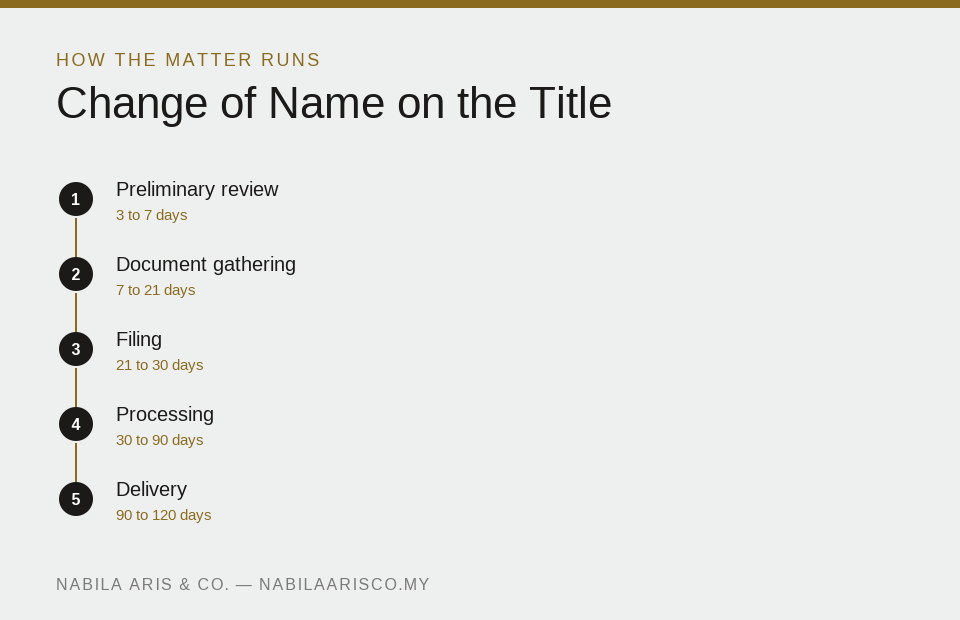
Changing the name on a title means changing the registered proprietor on the land register. The route depends entirely on the reason for the change, and choosing the wrong one means the application is rejected and the money already spent cannot be recovered.
Five reasons the name on a title has to change
Work out which one applies to you before going further. Each carries different documents, different stamp duty and a different timeline.
- A sale. The name passes to the buyer once the sale and purchase agreement is completed. See our subsale conveyancing for buyers.
- A gift to family. Parent to child, husband to wife, between siblings. This is a love and affection transfer and it carries its own stamp duty relief.
- The owner has died. This is an estate matter first, not a name change. It runs through small estate distribution, letters of administration or a grant of probate before the title can be transferred.
- Strata property. Apartments and condominiums where the strata title has been issued. See strata property transfers.
- The name does not match your identity card. The owner is the same person, only the register needs correcting. We cover that route below.
When a change of name on title is not simply a correction
If the discrepancy exists because the property is in fact registered to someone else, or because the registered proprietor has died, this is no longer a name correction. It becomes a transfer or an estate administration matter, with a different process and cost.
A land search at the outset will determine which of the two it is.
Common causes for a change of name on title
Among the causes we see most often: the name format in older documents differs from the current format, a spelling difference at original registration, or an official change of name after the property was purchased.
Sometimes the difference is small, a single letter. From a land registration standpoint, small or large does not matter. What matters is that the register must clearly show that the registered proprietor and the person dealing with the property are the same.
Why even a small difference becomes a problem
The land office registers dealings on an exact match between the name on the title and the name on your identity card. Differences that look trivial, such as the spelling of bin and binti, a hyphen, or a shortened name, are enough for an application to be rejected.
The problem is not on the day you notice the difference. It is on the day you need to sell, charge or resolve an estate, with a buyer or a bank waiting.
Check your title now against your current identity card. If there is a difference, deal with the correction while there is no time pressure.
Supporting documents needed
Usually you need copies of the old and the new identity card, an official document showing the change of name such as a deed poll or a court document, and a statutory declaration confirming that both names refer to the same person.
For a change of name after conversion to Islam, documents from the state religious authority are needed. For a change after marriage or divorce, the relevant certificate is needed.
If the original document evidencing the change cannot be traced, the route becomes longer and may require a court application. That is why it is better dealt with early.
How long it takes
Where the supporting documents are complete and nothing else sits on the title, a name correction is usually completed within a few weeks of filing.
Where the evidence of the name change cannot be traced, or where the name differs in more than one way, it takes longer and may need further statutory declarations.
A transfer route takes longer again, because it involves valuation and stamping. Expect several months, depending on the land office workload.
If the registered proprietor has died, this is not a name correction at all. It is an estate matter, and the route is entirely different. Check this early so you do not file the wrong application.
What it costs
Cost follows the route. A name correction involves land office registration fees, the cost of statutory declarations, the search fee and legal fees. It is far cheaper than a transfer.
A transfer carries stamp duty on the statutory scale, plus legal fees under the Solicitors Remuneration Order 2023. A love and affection transfer between close family members attracts specific relief.
The full breakdown by route is set out in our guide to the title transfer process and its costs. For a figure specific to your case, send us the details.
What we handle
- An official land search to confirm the registered name and anything sitting on the title
- Advice on which route applies, before any money is spent
- Preparing the transfer instrument or the correction application
- Statutory declarations and supporting documents
- Stamping and registration at the land office
- A confirmatory search once registration is complete
Questions worth asking
How is my name recorded on the title, and how does that differ from my current identity card.
Which route applies to my situation, and why.
What documents are needed to prove the change of name.
Can this be done at the same time as another dealing, such as a discharge of charge.
What happens if the original evidence of the name change cannot be traced.
When to start
Now, if you already know there is a difference. There is nothing to gain by waiting, and each year makes the supporting documents harder to obtain.
If you are planning to sell or to charge the property, deal with it first. Buyers and banks will not proceed until the names match.
If the registered proprietor is elderly, it is more urgent. After death the same matter becomes an estate administration that takes far longer.
I appointed them to handle my parents property matter and everything was handled smoothly and professionally. She explained everything clearly, was very patient with all of our questions and kept us updated throughout the process.
Athirah Azham · Google
Patient, takes the time to explain every term and procedure in detail, and has been very efficient in providing timely updates throughout the process. Whether you are purchasing a home for the first time or have been through the process before.
Aifa Azmi · Google
Excellent service throughout my property transfer transaction. The conveyancing team was professional, responsive, and efficient, keeping me informed at every stage.
Marina Mardi · Google
Rated 5.0 from 9 Google reviews.
What your lawyer handles in a change of name on the title
- Conducting a land search and identifying the cause of the discrepancy
- Gathering supporting documents proving that the registered proprietor and the applicant are the same person
- Preparing the application and any statutory declaration required
- Filing the application at the land office
- Coordinating with the bank if it holds the title in custody under a charge
- Retrieving the corrected title
Timeline for a change of name on the title
Documents to prepare for a change of name on the title
- Copy of the current identity card
- Copy of the old identity card if available
- Copy of the title
- Birth certificate or other document showing the original name
- Official change of name documents where applicable
Costs people overlook in a change of name on the title
- Legal fees for the application
- Land office filing fee
- Cost of the statutory declaration and document certification
- Service tax of 8% on legal fees
When to stop and get advice first
- The discrepancy exists because the register names a different person, not because of a misspelling
- The registered proprietor has died, which makes it an estate matter rather than a name correction
- Nobody can trace supporting documents linking the old and new names
- The title is in the bank's custody and the bank has its own procedure
Frequently asked questions about change of name on title
Why is the name on my title different?
Common causes include a different name format in older documents, a spelling correction at original registration, or an official change of name after you bought the property.
Does it stop me selling the house?
Yes. A buyer and a financing bank need certainty that the registered proprietor and the seller are the same person.
How long does it take?
Usually two to four months, depending on the land office workload and how complete the supporting documents are.
How is it different from a transfer?
A name correction does not change ownership. It only reconciles the particulars of the same owner. A transfer moves ownership to a different person.
What does it cost to change the name on a property title?
Cost follows the route. A name correction involves registration fees, statutory declarations, a search fee and legal fees. A transfer carries stamp duty on the statutory scale plus legal fees under the Solicitors Remuneration Order 2023.
How do I transfer a house to my child?
That is a love and affection transfer. It is a full transfer of ownership rather than a name correction, and specific stamp duty relief applies to transfers between close family members.
Can the name be changed if the owner has died?
Not directly. The estate has to be resolved first, through small estate distribution, letters of administration or a grant of probate. Only then can the title be transferred to the beneficiaries.
Ready to start your property matter?
An initial consultation with no obligation. Tell us about your matter and we will explain what is involved and what it is likely to cost.
No 1, Jalan Setia Dagang AL U13/AL, Setia Alam, 40170 Shah Alam, Selangor
014-4004293 · Monday to Friday, 9:00am to 5:00pm