National Land Code: What It Is, Where It Applies, and the Parts That Affect You
The National Land Code governs land ownership and dealings in Peninsular Malaysia. What it is, since when, why it does not apply in Sabah and Sarawak, and which provisions touch an ordinary property matter.
Updated 10 October 2026 · Written and reviewed by Nur Nabilah Binti Mohd Aris

The National Land Code is the federal statute governing land ownership, registration and dealings in Peninsular Malaysia. It was passed as Act 56 of 1965 and came into force on 1 January 1966. Following a revision gazetted on 15 October 2020 it is cited as Act 828, with section numbers unchanged. It does not apply in Sabah or Sarawak, which have their own land laws. The Code runs a Torrens system: ownership is determined by what is on the register at the land office, not by the documents a person holds.
What this National Land Code guide covers
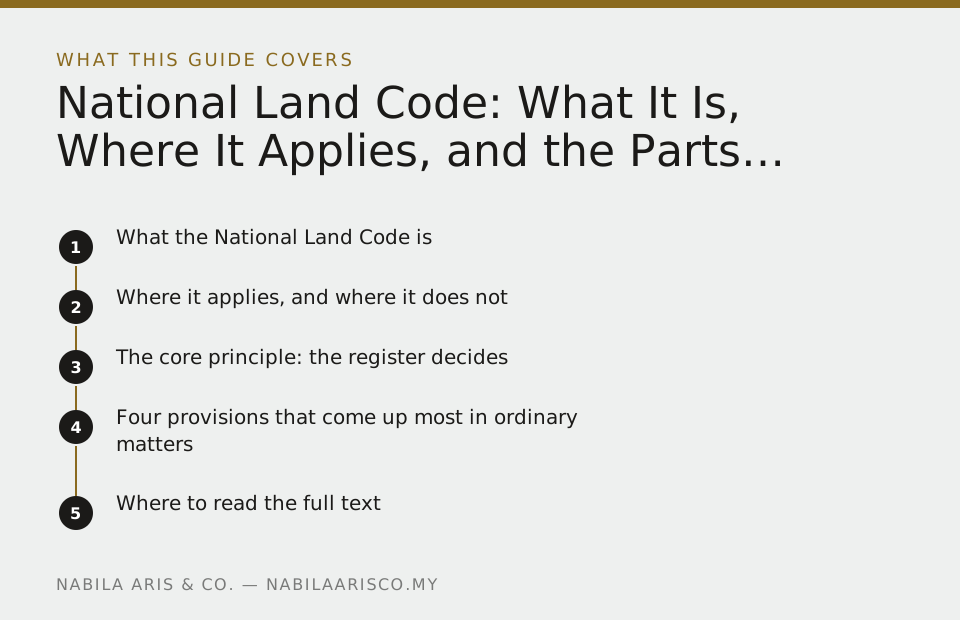
If you are buying, selling or inheriting land in Peninsular Malaysia, almost every step your solicitor takes traces back to one statute: the National Land Code. This page sets out what it is, where it applies, and which parts actually touch an ordinary property matter.
What the National Land Code is
The National Land Code is the federal statute that unifies land law across Peninsular Malaysia: how title is granted, how it is registered, and how it changes hands.
It was passed as Act 56 of 1965 and came into force on 1 January 1966. On 15 October 2020 it was revised under the Revision of Laws Act 1968, and since then its official citation is Act 828. Section numbers were not changed, so older references such as section 340 still point to the same provision.
| Item | Detail |
|---|---|
| Original citation | Act 56 of 1965 |
| Current citation | Act 828 (Revised 2020) |
| In force from | 1 January 1966 |
| Application | Peninsular Malaysia only |
| Structure | 6 Divisions, 35 Parts, 447 sections, 16 Schedules |
Where it applies, and where it does not
The National Land Code applies across the states of Peninsular Malaysia and the Federal Territories. It does not apply in Sabah or Sarawak.
Sabah operates under the Sabah Land Ordinance and Sarawak under the Sarawak Land Code. Both have their own title types, forms and procedures.
The core principle: the register decides
The Code operates a Torrens system. Ownership is determined by what appears on the register at the land office, not by who holds the paperwork or who paid.
Section 340 gives this effect. A registered title or interest is indefeasible, subject to stated exceptions such as fraud, misrepresentation or a void instrument.
Two practical consequences for a buyer:
- Signing the sale and purchase agreement does not make you the owner. You become the owner when the transfer is registered.
- The official land search is not a formality. It is the only way to know what is actually on the register: the proprietor’s name, charges, caveats and restrictions.
Four provisions that come up most in ordinary matters
The Code runs to 447 sections, but a handful recur in everyday subsale work.
| Section | What it does | Why it matters to you |
|---|---|---|
| 340 | Registered title is indefeasible | Registration decides ownership, not the agreement |
| 214A | Control on the transfer of estate land | Certain dealings need State Authority approval before they can move |
| 433B | Non-citizens and foreign companies need state consent | A foreign buyer cannot simply register without approval |
| 323 | Private caveats | A party claiming an interest can freeze dealings on the title |
Separately there are restrictions in interest endorsed on the title itself. These vary lot by lot, and usually mean the title cannot be transferred, charged or leased without State Authority consent. Restrictions in interest are the single most common reason a subsale takes an extra two to four months.
Where to read the full text
The official text can be downloaded as a PDF from the Attorney General’s Chambers legislation portal, under the citation Act 828.
One caution: the full text runs to 447 sections and is written for courts, not for house buyers. If you are trying to understand one specific matter, it is faster to look up the relevant provision than to read from page one.
Land law also does not stop at this Code. State land rules, Malay reservation enactments, customary land law and the strata legislation all operate alongside it.
Why this matters to an ordinary buyer
Most people never need to read the National Land Code. But understanding three things saves a lot of frustration:
- Signing is not owning. Between signing the agreement and registering the transfer there is a period where the title is still in the seller’s name. A caveat is normally entered to protect the buyer’s position during it.
- Delay usually comes from the title, not the solicitor. Restrictions in interest, state consent and an unsubdivided master title all add time that nobody can compress.
- The official search is cheap compared with what it prevents. It shows charges, caveats and restrictions before you are committed.
Related guides
- Subsale timeline: from SPA to title registration
- The caveat process
- Property glossary, English and Malay
- Property lawyer in Shah Alam
Frequently asked questions about National Land Code
Does the National Land Code apply in Sabah and Sarawak?
No. It applies in Peninsular Malaysia only. Sabah operates under the Sabah Land Ordinance and Sarawak under the Sarawak Land Code, each with its own title types, forms and procedures.
What is the difference between Act 56 of 1965 and Act 828?
They are the same statute. Act 56 is the original 1965 citation. After a revision under the Revision of Laws Act 1968, gazetted on 15 October 2020, the official citation became Act 828. Section numbers were not changed.
I have signed the sale and purchase agreement. Am I the owner?
Not yet. Under the Torrens system ownership passes when the transfer is registered at the land office, not when the agreement is signed. A caveat is normally entered to protect the buyer's position in between.
What is a restriction in interest?
It is an endorsement on the title limiting certain dealings, usually meaning the title cannot be transferred, charged or leased without State Authority consent. It varies lot by lot and can only be confirmed by an official search.
Can a foreigner buy land under the Code?
Section 433B requires non-citizens and foreign companies to obtain State Authority approval before acquiring land. States also set their own minimum prices and conditions.
Where can I download the National Land Code PDF?
The official text is available from the Attorney General's Chambers legislation portal under the citation Act 828.
Ready to start your property matter?
An initial consultation with no obligation. Tell us about your matter and we will explain what is involved and what it is likely to cost.
No 1, Jalan Setia Dagang AL U13/AL, Setia Alam, 40170 Shah Alam, Selangor
014-4004293 · Monday to Friday, 9:00am to 5:00pm