
A Bumiputera lot carries a restriction in interest on the title that requires consent before any transfer. A lot marked as a Bumiputera reserve on the title is subject to a restriction in interest. A transfer to a non-Bumiputera buyer requires State Authority consent, and that consent is not guaranteed. This has to be checked before any deposit is paid.
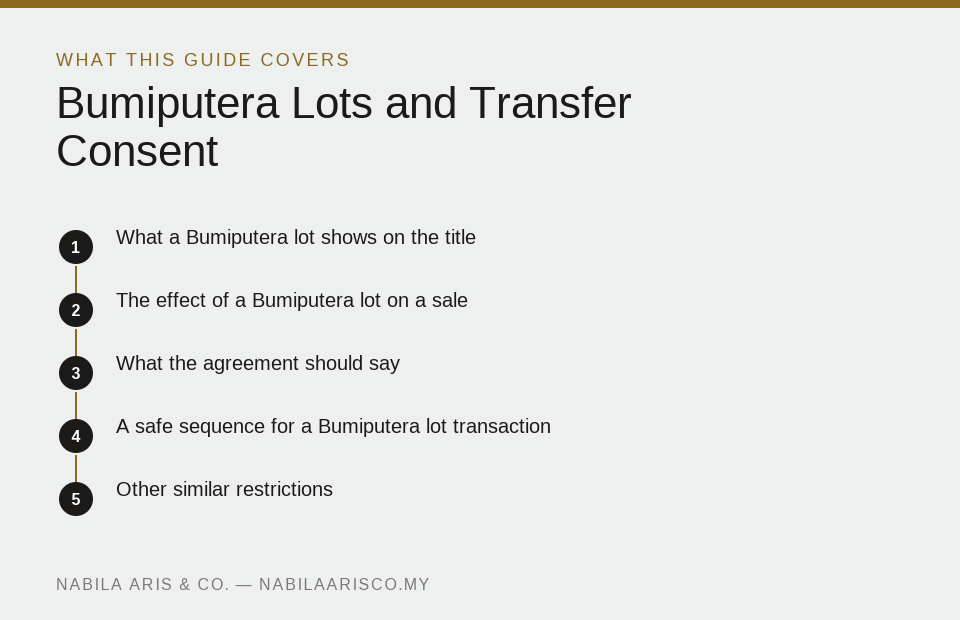
What this Bumiputera lot guide covers
A Bumiputera reserve restriction is one of the title issues that most often causes a transaction to fail after money has already changed hands. It is not something to deal with later. It has to be found before signing.
What a Bumiputera lot shows on the title
A restriction in interest is endorsed on the title itself. An official title search will show it. This is another reason the search belongs before the deposit is paid, not after the sale and purchase agreement is signed.
Without a clause making the sale subject to consent, a buyer who fails to obtain consent may be treated as in breach, and the deposit can be forfeited.
The effect of a Bumiputera lot on a sale
- A transfer to a non-Bumiputera buyer cannot be registered without consent
- The consent application takes time and has its own queue
- Consent can be refused, and refusal means the matter cannot complete as planned
- A bank may be unwilling to approve financing until the consent position is clear
What the agreement should say
If the transaction depends on consent, the agreement should state clearly that the sale is subject to consent to transfer from the relevant authority, and what happens if consent is not obtained: whether the agreement is terminated, whether the deposit is refunded, and how long the parties will wait.
Without that clause, a buyer who fails to obtain consent may be treated as in breach, and the deposit can be forfeited. That outcome is entirely avoidable with proper drafting.
The completion period should also allow for the consent process. Applications take time, and the usual three months is often not enough.
A safe sequence for a Bumiputera lot transaction
- Official title search before any payment
- Confirm whether a restriction exists and what its terms are
- If consent is needed, include a conditional clause in the agreement
- Start the consent application as early as possible
- Do not assume a tight completion date until the consent position is clear
Other similar restrictions
A Bumiputera reserve is not the only restriction that can appear on a title. There is also Malay reserve land, land held on an agricultural condition that needs a change of condition, and property carrying a restriction in interest imposed when the title issued.
Each has its own process and timeline, and each has to be read and understood rather than treated as a formality.
A title search will show which restrictions exist on that title. That is why the search belongs before signing, not after.
Non-citizen buyers
A purchase by a non-citizen carries its own layer of consent under the National Land Code 1965, on top of state-set minimum price thresholds. This is a separate issue from a Bumiputera restriction and has to be assessed separately. The full position for a non-citizen buyer is in our guide to section 433B state consent.
If consent is refused after signing
Where the agreement contains a clause making the sale subject to consent, a refusal normally allows the transaction to be terminated and the deposit returned.
Without that clause, the buyer may be treated as in breach even though the refusal was not their fault.
That is why the clause belongs in the review before signing. It is one sentence that decides whether you lose the deposit or not.
Questions worth asking before signing
What restrictions appear on the title, according to an official search.
Whose consent is needed, and how long it usually takes.
What the agreement says if consent is refused.
Whether the completion period allows for the consent process.
What risk I carry if I proceed without that clause.
Documents needed for the consent application
Start with an official title search. The wording of the restriction itself decides whose consent is required, and that wording is not identical from one lot to the next.
Prepare a copy of the title, identity documents for buyer and seller, and the signed sale and purchase agreement.
The state application form has to be completed in the prescribed format, together with the relevant fee.
Have current quit rent receipts ready as well, since applications involving arrears are commonly returned.
Where either party is a company, registration documents and a directors resolution are needed. Reading a land title helps you identify which parts of the document have to be copied.
What most often holds up a consent application
An application started only once loan documentation is already running. Consent follows the queue at the state office, and that queue is not shortened by the date in your agreement.
An incomplete form, or particulars that do not match the title. Every correction means another round of resubmission.
Quit rent arrears that the seller has yet to clear.
A bank waiting on the consent position before proceeding with documentation, while you are waiting on the bank. Both sides can stall at once where the sequence is not planned early.
Mistakes we see most often on restricted titles
The first is relying on what a seller or an agent says about the title. Only an official search confirms a restriction, and it is cheap set against the consequences.
The second is signing without a conditional clause. Without it, a refusal of consent can be read as a default by the buyer.
The third is treating removal of a restriction as a formality. It is a decision of the authority, not an administrative step that is certain to pass.
The fourth is letting a consent letter expire before registration is done, which means applying again from the beginning.
I appointed them to handle my parents property matter and everything was handled smoothly and professionally. She explained everything clearly, was very patient with all of our questions and kept us updated throughout the process.
Athirah Azham · Google
Patient, takes the time to explain every term and procedure in detail, and has been very efficient in providing timely updates throughout the process. Whether you are purchasing a home for the first time or have been through the process before.
Aifa Azmi · Google
Excellent service throughout my property transfer transaction. The conveyancing team was professional, responsive, and efficient, keeping me informed at every stage.
Marina Mardi · Google
Rated 5.0 from 9 Google reviews.
Frequently asked questions about Bumiputera lot
Can a Bumiputera restriction be removed from the title?
This is not something the parties to a sale can decide. It depends on the policy and discretion of the State Authority.
How long does a consent application take?
It depends on the state and the circumstances. What matters is not fixing a tight completion date before the consent position is clear.
What if consent is refused after I have paid a deposit?
This depends entirely on the clause in the agreement. If the agreement makes no provision for it, your position is far weaker. Check before signing.
Do Bumiputera buyers need consent as well?
A transfer between parties who satisfy the terms of the restriction does not usually face the same issue. The exact position has to be checked against the endorsement on the title.
How do I know whether a property is a restricted lot?
An official title search will show it. Property listings and spoken assurances are not a basis to rely on for this.
Can the restriction be removed?
An application can be made to the state authority, but the decision rests with them. Plan the matter on the footing that consent is not guaranteed.
Are the rules the same in every state?
No. The framework is uniform under the National Land Code, but state policy, forms and practice differ, so check according to where the property sits.
What should I do if the agreement is already signed without a conditional clause?
Review the terms you have and the position of the deposit before making any further payment. You are welcome to contact our firm to assess the options still open.
Ready to start your property matter?
An initial consultation with no obligation. Tell us about your matter and we will explain what is involved and what it is likely to cost.
No 1, Jalan Setia Dagang AL U13/AL, Setia Alam, 40170 Shah Alam, Selangor
014-4004293 · Monday to Friday, 9:00am to 5:00pm