
Buying commercial property uses the same legal fee scale as residential, but the express condition on the title must match the intended use. Business licences, fire permits and other approvals do not pass automatically with the title and must be applied for afresh. Check the Certificate of Completion and Compliance, any existing tenancy agreements, and remember that banks give lower margins and shorter tenures on commercial property.
What this buying commercial property guide covers
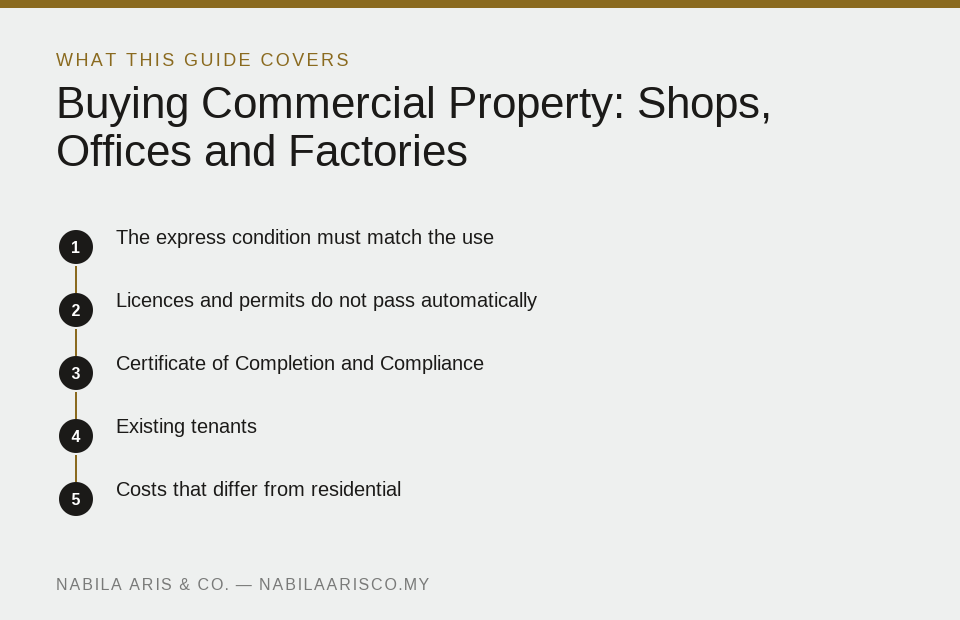
Buying a shop, office or factory uses the same legal fee scale as residential property, but almost everything else differs. Buyers who carry their home-buying experience into a commercial matter are often caught out midway.
Express condition must match the use when buying commercial property
The title carries an express condition setting out the permitted use: building, commercial, industrial or agricultural. Running a factory on a building-condition lot breaches that condition, and the authorities can act on it.
Check the express condition on the title search before placing a deposit, and make sure it matches what you plan to do. Varying it needs State Authority approval, a premium, and a waiting period that cannot be shortened.
Licences and permits do not pass automatically
This is the most expensive misunderstanding. Buying the building does not mean you inherit the seller business licence, fire permit or environmental approval.
Each has to be applied for afresh in the name of your entity. For a factory that can mean several separate approvals from different authorities, and some take months.
Plan for that period before signing, not after. If your business must be operating by a particular date, that date depends on approvals rather than on handover of keys.
Buying the building does not mean you inherit the seller business licence, fire permit or environmental approval. Each has to be applied for afresh in the name of your entity.
Certificate of Completion and Compliance
Check that the building holds a valid CCC, and that any alteration or extension was approved. A structure built without approval becomes the buyer problem after transfer, not the seller.
For a factory, also check that the existing floor loading and power supply match your operational needs. Upgrading an industrial electricity supply is not a small cost.
Existing tenants when buying commercial property
Where the property comes with tenants, the existing tenancy agreements continue to bind you after transfer. Check the terms, the unexpired period, the deposits held, and whether there is a renewal option in the tenant favour.
Ask for copies of every agreement and the deposit position before signing, not after.
Costs of buying commercial property compared with residential
Legal fees follow the Solicitors Remuneration Order 2023, the same as residential. Transfer stamp duty uses the same scale.
What differs is financing. Banks assess commercial property differently, margins are usually lower, and loan tenures shorter. Some banks also require a formal valuation before approving.
Budget as well for commercial assessment, which is higher than residential, and for ongoing compliance costs such as fire inspections.
How long buying commercial property takes
A bank-financed commercial matter usually runs longer than a residential subsale, because valuation, approvals and compliance checks run in parallel. Plan for four to six months, and longer where a change of condition is involved.
The stages of a commercial purchase and the cost at each
Before signing, the title, the express condition and the approved use are checked. Search costs at this stage are modest, but this is the stage that decides whether the purchase should go ahead at all.
On the day the agreement is signed, the deposit and part of the professional fee are called for. Service tax applies to the professional fee and belongs in your figures.
When the transfer and the financing documents are prepared, stamp duty on both has to be settled before they can be completed.
At registration, the land office fee and the balance of the fees are settled. Where the premises are let, rent apportionment and the tenant deposits are dealt with at this stage as well.
Documents to review before buying commercial property
The title has to be checked for the express condition, restrictions in interest, caveats and any existing charge. An express condition that does not match the use you have planned is an expensive problem to fix.
The certificate of completion and compliance and the approved plans should be seen, along with any approval for alterations already carried out.
Licences and permits attached to the premises have to be checked, because they do not pass automatically to a new owner.
Where the premises are let, the existing tenancy agreements, deposit receipts and rent payment records have to be examined. The obligations under those agreements pass to you.
The costliest mistakes in a commercial purchase
The first is assuming commercial premises can be used for any business. The use has to match the express condition on the title and the approval given by the local authority.
The second is assuming the licences of the seller pass with the property. Licences and permits have to be applied for again in your own name, and the time that takes can affect when you can begin trading.
The third is applying a residential budget to a commercial purchase. The cost structure differs, and service tax on the professional fee belongs in the calculation from the outset.
The fourth is buying tenanted premises without reading the existing tenancy agreements. The obligations and the deposits pass to you, unfavourable terms included.
Where the money goes in a commercial purchase
The professional fee goes to the firm handling the agreement, the transfer and the financing documents. That part follows a set scale.
Stamp duty goes to the stamp authority through the solicitors, and service tax applies to the professional fee.
Search fees and registration fees go to the land office. Fees connected with licences and permits go to the authority that issues them.
Management body charges or building service charges go to the building management. Check the legal fee portion in the legal fee calculator, then ask for the remaining costs to be itemised by recipient.
I appointed them to handle my parents property matter and everything was handled smoothly and professionally. She explained everything clearly, was very patient with all of our questions and kept us updated throughout the process.
Athirah Azham · Google
Patient, takes the time to explain every term and procedure in detail, and has been very efficient in providing timely updates throughout the process. Whether you are purchasing a home for the first time or have been through the process before.
Aifa Azmi · Google
Excellent service throughout my property transfer transaction. The conveyancing team was professional, responsive, and efficient, keeping me informed at every stage.
Marina Mardi · Google
Rated 5.0 from 9 Google reviews.
Frequently asked questions about buying commercial property
Does the seller business licence pass to me?
No. Licences and permits are issued to an entity, not to a building. Each must be applied for afresh in your name, and some take months.
Can I run a factory on a building-condition lot?
Not without varying the express condition first. Operating in breach of the condition can attract action from the authorities.
Why are commercial loan margins lower?
Because banks assess commercial property differently from residential. Loan tenures are usually shorter too, and some banks require a formal valuation.
Are the legal costs higher for commercial property?
The professional fee follows the same scale, but service tax and the additional checks make the overall figure different from a residential purchase. The components are compared in the guide to property legal costs.
Can I change the use of the premises after buying?
It needs approval, and approval is not guaranteed. Check the express condition and the current approvals before signing rather than after.
What happens to the existing tenants?
A valid tenancy continues and the obligations under it pass to you, including the deposits held. Ask for complete copies of every tenancy agreement.
Does commercial financing take longer?
Usually yes, because the valuation and the document review are more involved. Plan your completion period with a wider margin.
What is the first step to take?
Obtain a copy of the title and a list of the licences attached to the premises, then ask for a review before the deposit is paid. Send the details through the contact page.
Ready to start your property matter?
An initial consultation with no obligation. Tell us about your matter and we will explain what is involved and what it is likely to cost.
No 1, Jalan Setia Dagang AL U13/AL, Setia Alam, 40170 Shah Alam, Selangor
014-4004293 · Monday to Friday, 9:00am to 5:00pm