Legal Guide for Property Investors
The legal issues that differ for investors: gains tax, multiple purchases, ownership through a company, and managing tenants.
Updated 4 September 2026 · Written and reviewed by Nur Nabilah Binti Mohd Aris

A property investor faces gains tax, retention sums and ownership choices that differ from an owner-occupier. For investors, two things affect returns most: real property gains tax on disposal and ownership structure. Ownership through a company carries a different RPGT rate after the sixth year compared with an individual citizen owner.
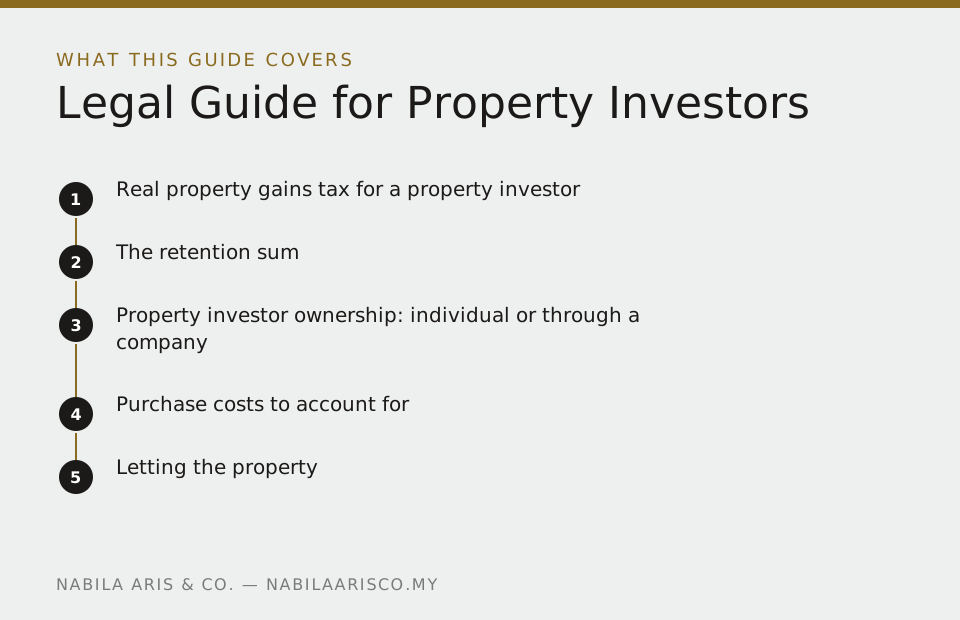
What this property investor guide covers
The legal cost of buying an investment property follows the same scale as buying a home to live in. What differs is what happens once you own it, and what happens when you dispose of it.
Real property gains tax for a property investor
This is the single largest component for an investor. The rate depends on the holding period and the disposer category.
| Holding period | Citizen & PR | Company | Non-citizen |
|---|---|---|---|
| Year one | 30% | 30% | 30% |
| Year two | 30% | 30% | 30% |
| Year three | 30% | 30% | 30% |
| Year four | 20% | 20% | 30% |
| Year five | 15% | 15% | 30% |
| Year six and beyond | 0% | 10% | 10% |
Note the difference after the sixth year. Individual citizens reach a zero rate, companies stay at 10%, and non-citizens stay at 10%. That difference matters when choosing an ownership structure.
The retention sum
On disposal, the buyer’s solicitor retains part of the sale price and remits it to the Inland Revenue Board within the prescribed period. The retention rate differs between citizen and non-citizen disposers. This means you do not receive the entire sale price immediately.
Property investor ownership: individual or through a company
- Individual. Simpler, lower administration cost, and reaches a zero RPGT rate after the sixth year for citizens.
- Company. Useful for multiple holdings and separating liability, but stays at the 10% RPGT rate with no time limit, and carries corporate compliance obligations.
The right choice depends on the number of properties, the planned holding period, and succession plans.
Financing differs too. A loan to a company usually carries different terms from an individual housing loan, and the company maintenance cost recurs every year.
This decision belongs before the first purchase, not after a portfolio has formed. Moving ownership from an individual to a company later is treated as a transfer, with stamp duty and potentially gains tax.
Purchase costs to account for
| Property price | Legal fees | Stamp duty | Estimated total |
|---|---|---|---|
| RM250,000 | RM6,413 | RM5,125 | RM13,538 |
| RM500,000 | RM12,825 | RM11,250 | RM26,075 |
| RM750,000 | RM18,090 | RM19,875 | RM39,965 |
| RM1,000,000 | RM23,220 | RM28,500 | RM53,720 |
| RM1,500,000 | RM33,480 | RM50,750 | RM86,230 |
Letting the property after buying
A properly drafted and stamped tenancy agreement is the foundation. An agreement that is not duly stamped may not be admissible in evidence in civil proceedings until the duty and penalty are paid. For an investor who may need to enforce the terms, that is not a small matter.
Templates downloaded and filled in without review usually fail to address what actually happens, such as a tenant who stops paying but refuses to leave.
For strata property, check the management body’s house rules. Some projects restrict short-term letting, and breaching that can lead to action.
Keep records of rental income and related expenses. Orderly records help for tax purposes and for computing allowable costs when the property is later sold.
What a property investor should check on every purchase
- Title search to confirm the proprietor, charges, caveats and restrictions
- For strata, arrears of maintenance charges and the state of the management body
- Whether the property is tenanted and the terms of any existing agreement
- Outstanding quit rent and assessment
- Ownership history where the price is well below market
Run the title search before signing, without exception. It is not a step to skip because you have bought several properties before.
Check the unexpired lease term on leasehold property too. A short remaining term affects your buyer’s financing later, not only your own now.
A property bought with a tenant in place carries obligations that pass to you.
Questions worth asking on each purchase
What the title search shows about restrictions, charges and caveats.
What the unexpired lease term is, and how that will affect a future buyer’s financing.
Whether the property is tenanted, and what obligations pass to me.
What the gains tax position will be if I sell within the chargeable period.
Whether ownership in my own name or through a company suits my plan better.
If the investment is a shop, an office or a factory, the checks differ from residential. See buying commercial property.
Frequently asked questions about property investor
Is RPGT charged if I make a loss?
RPGT is charged on a gain. If there is no gain, there is no gains tax. But the obligation to file the forms within the prescribed period still applies.
Is it better to buy in my own name or through a company?
It depends on the number of properties, the planned holding period and succession plans. The difference in RPGT rates after the sixth year is a major factor.
How long should I hold before selling?
From a tax standpoint alone, the rate falls with the holding period and reaches zero after the fifth year for individual citizens. But an investment decision involves more than the tax rate.
Do I need a written tenancy agreement?
Yes. Without a written and stamped agreement your position is far weaker when a dispute with a tenant arises.
Ready to start your property matter?
An initial consultation with no obligation. Tell us about your matter and we will explain what is involved and what it is likely to cost.
No 1, Jalan Setia Dagang AL U13/AL, Setia Alam, 40170 Shah Alam, Selangor
014-4004293 · Monday to Friday, 9:00am to 5:00pm