Bank Foreclosure: What You Can Do and When
A bank foreclosure does not begin at the auction. A letter from the bank solicitors is not the end of the road, but it is the start of a clock. Every stage after it has a date, and your options narrow at each one. A Form 16D notice is not an ordinary reminder letter For […]
Updated 17 November 2026 · Written and reviewed by Nur Nabilah Binti Mohd Aris
A default notice on a housing loan is issued in Form 16D under section 254 of the National Land Code, usually after four consecutive missed instalments, and it must be served personally. If it is not remedied, the bank applies for an order for sale. The reserve price is fixed at estimated market value, and if the property sells below what you owe, the shortfall remains your debt.
What this bank foreclosure guide covers
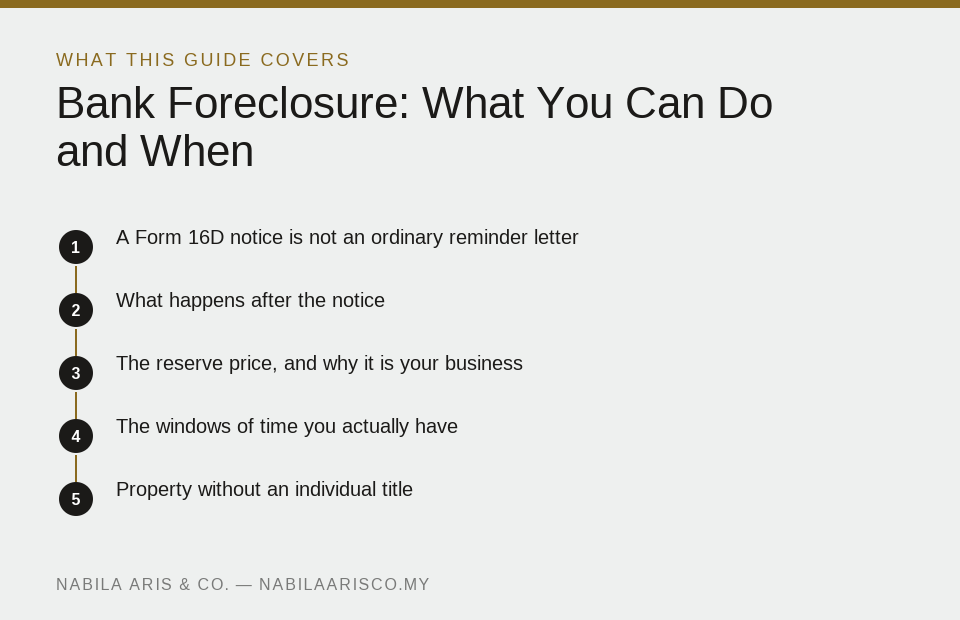
A bank foreclosure does not begin at the auction. A letter from the bank solicitors is not the end of the road, but it is the start of a clock. Every stage after it has a date, and your options narrow at each one.
A Form 16D notice is not an ordinary reminder letter
For a housing loan repayable by instalments, the default notice is issued in Form 16D under section 254 of the National Land Code 1965. It is usually issued after four consecutive monthly instalments go unpaid, and it has to be served on the borrower personally.
For a loan repayable on demand, such as a business overdraft, the form used is Form 16E under section 255. The text of the National Land Code can be checked on the Laws of Malaysia portal. The procedure differs, so check which form you received.
The difference between a bank reminder letter and a Form 16D matters. A reminder is administrative. A Form 16D is a statutory step that opens the way to an application for an order for sale. If you have received a Form 16D, the date on the form is what you need to note, not the date you read it.
What happens after the notice in a bank foreclosure
If the default is not remedied within the period stated in the notice, the bank applies for an order for sale.
For a title registered at state level with the Director of Lands and Mines, the application goes to the High Court under section 256. For a title registered at the District Land Office, the application goes to the Land Administrator and the proceedings run at the land office rather than in court. Your type of title decides the forum, and it is printed on the title. If you are not sure, our land office guide explains how to read it.
Once an order for sale is granted, an auction date is fixed and the property is advertised. At this stage the property is still in your name and you can still redeem it, but the amount payable now includes the bank legal costs and the costs of the proceedings.
Many owners assume the auction price is no longer their concern. If the property sells for less than what you owe, the shortfall remains your debt.
The reserve price, and why it is your business
Many owners assume the auction price is no longer their concern because the property is going anyway. That is an expensive misunderstanding.
Under section 257(1)(d), the reserve price is fixed at the estimated market value of the property. If the property sells for less than what you owe, the shortfall remains your debt. The bank can pursue it after the auction concludes. So a reserve price set too low means you lose the house and still owe money.
A bank valuation can be challenged. A borrower can put forward their own valuation and argue the reserve. But there is a balance to understand: a reserve set too high can mean no bidders, a failed auction, and the process repeating with added cost. In one Kuala Lumpur matter the court fixed the reserve at RM525 per square foot even though the borrower valuer proposed RM650, because the higher figure risked aborting the auction itself.
One further point in your favour. The successful bidder pays a 10 per cent deposit and normally has to settle the balance within 90 days. Extending that period requires the consent of the chargor, which is you. Without that consent the sale can be void, as in M&J Frozen Food Sdn Bhd v Siland Sdn Bhd [1994] 1 MLJ 294.
The windows of time you have in a bank foreclosure
- Before the Form 16D. This is the cheapest point to act. Restructuring, rescheduling, or selling on the open market yourself are all still available, and the bank legal costs have not yet been added.
- After the Form 16D, before the order for sale. Remedying the default within the notice period stops the process. After that, the costs of the proceedings start being added to your debt.
- After the order for sale, before the auction. Redemption is still possible but the figure is larger. Selling yourself at market price at this stage often produces a better result than the auction, if the bank agrees and there is time.
- After the auction. The options are nearly gone. What remains is usually the question of surplus or shortfall.
The pattern we see repeat: owners wait until the third stage before taking advice, because the first two feel like there is still time. The cost difference between acting at the first stage and the third can run to tens of thousands of ringgit.
Property without an individual title
If the individual or strata title has not yet issued, your property is not held under a registered charge. It is held under a deed of assignment.
The Form 16D and order for sale procedure under the National Land Code does not apply here. The bank instead acts on the terms of that deed and on the loan agreement, and usually has to obtain a court judgment first.
What that means for you: the timeline is different, the documents you receive are different, and advice given for a registered charge may not apply. Check first whether the individual title has issued for your project, because that decides which route you are on.
After the auction: surplus and shortfall
If the property sells for more than the debt, costs and charges, the surplus belongs to you. It is not returned automatically in every situation, so claim it and keep a record of the sale price and the bank settlement statement.
If it sells for less, the shortfall remains your debt and the bank can pursue it. Check the calculation. A settlement statement normally includes interest, late charges, legal costs and the costs of the proceedings, and each should be checked against your loan agreement.
What most often costs borrowers money in a bank foreclosure
- Not opening letters from the bank and its solicitors, so the notice period passes unnoticed
- Assuming a verbal discussion with a bank officer stops the legal process. It does not, unless there is a written agreement
- Letting the reserve price be fixed without scrutiny, when the shortfall after the sale falls on you
- Waiting until after the order for sale before trying to sell privately
- Making small inconsistent payments that are not enough to remedy the default but drain the savings that could have funded a settlement
If you have received anything from the bank solicitors, bring all of it: the original loan offer letter, the latest account statement, every notice received with its envelope, and a record of the payments you have made. The dates on those documents decide which options remain.
If the account is already in default, the two matters that usually follow are a discharge of charge once the debt is settled and, if the property is sold at auction, buying property at auction.
I appointed them to handle my parents property matter and everything was handled smoothly and professionally. She explained everything clearly, was very patient with all of our questions and kept us updated throughout the process.
Athirah Azham · Google
Patient, takes the time to explain every term and procedure in detail, and has been very efficient in providing timely updates throughout the process. Whether you are purchasing a home for the first time or have been through the process before.
Aifa Azmi · Google
Excellent service throughout my property transfer transaction. The conveyancing team was professional, responsive, and efficient, keeping me informed at every stage.
Marina Mardi · Google
Rated 5.0 from 9 Google reviews.
Frequently asked questions about bank foreclosure
What is a Form 16D?
A statutory default notice under section 254 of the National Land Code for a loan repayable by instalments. It differs from a bank reminder letter because it opens the way to an application for an order for sale.
When can the bank issue a Form 16D?
Usually after four consecutive monthly instalments go unpaid. The notice must be served on the borrower personally.
What if the house sells for less than the debt?
The shortfall remains your debt and the bank can pursue it. That is why the reserve price matters even though you are losing the property.
Can I challenge the bank valuation?
Yes. A borrower can put forward their own valuation. But a reserve set too high risks no bidders and a repeat auction with added cost.
Can I still sell it myself?
Yes, and the result is often better than an auction. But it needs the bank agreement and enough time, so the stage before the order for sale is the best point.
The individual title has not issued. Is the procedure the same?
No. Without an individual title the property is held under a deed of assignment, not a registered charge. The Form 16D procedure does not apply and the bank usually needs a court judgment first.
Ready to start your property matter?
An initial consultation with no obligation. Tell us about your matter and we will explain what is involved and what it is likely to cost.
No 1, Jalan Setia Dagang AL U13/AL, Setia Alam, 40170 Shah Alam, Selangor
014-4004293 · Monday to Friday, 9:00am to 5:00pm