Co-Owner Refuses to Sell: Section 145 and Your Options
A co-owner who refuses to sell is the most common deadlock we see on family property. Two or three names on one title, and one of them will not sell. The property is stuck, the taxes keep running, and nobody can do anything. There is a way out of this in the National Land Code, […]
Updated 8 November 2026 · Written and reviewed by Nur Nabilah Binti Mohd Aris

Co-ownership means holding undivided shares under section 342(1) of the National Land Code, so every dealing needs every registered proprietor. Where one refuses, section 145 allows any co-proprietor to apply to court. The court may order partition, the transfer of one share to the others, or a sale of the land. One person refusing is not a permanent veto.
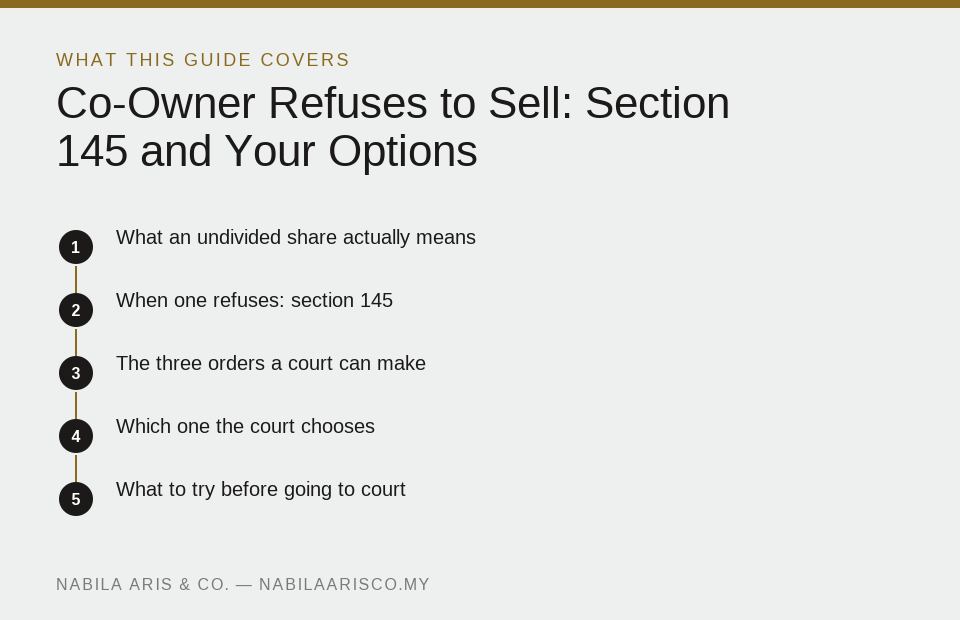
What this co-owner refuses to sell guide covers
A co-owner who refuses to sell is the most common deadlock we see on family property. Two or three names on one title, and one of them will not sell. The property is stuck, the taxes keep running, and nobody can do anything. There is a way out of this in the National Land Code, and it is rarely known.
What an undivided share actually means
Section 342(1) of the National Land Code defines co-proprietorship as holding alienated land in undivided shares. The important word there is undivided.
It means that if you hold a half share, you do not hold a particular half of the land. You hold half of the whole of it. There is no back portion that is yours and front portion that is someone else, even where the family has long agreed verbally that it works that way.
The practical effect is one thing: every dealing needs every registered proprietor. A sale, a charge, and most other dealings cannot be registered without all of their signatures. One person refusing is enough to stop everything.
A co-proprietor also cannot unilaterally designate which portion is theirs without the agreement of all. A family understanding about who lives where does not change what the title records.
When one refuses: section 145
The National Land Code anticipates this situation. Section 145(1) applies where a co-proprietor will neither join in, nor consent to the making of, an application for partition.
In that case, any co-proprietor may apply to court. The full text of the National Land Code is on the Laws of Malaysia portal. The court may then make whatever order it considers just to enable the co-proprietorship to be terminated.
This is the most important point to take: you are not trapped. One co-proprietor refusing is not a permanent veto. It is a problem with a legal route, and that route ends in a decision rather than a deadlock.
Co-proprietorship is held in undivided shares. You do not hold a particular portion of the land, and every dealing needs the signature of every registered proprietor.
When a co-owner refuses to sell: the three orders a court can make
Section 145(2) sets out the options, and the three produce completely different outcomes.
| Order | What happens | Suits when |
|---|---|---|
| Partition | An application by one or more co-proprietors is deemed made by all, subject to equitable payments reflecting the comparative values of the portions | The land is large enough to divide and each portion remains usable |
| Transfer of a share | One co-proprietor undivided share is transferred to the others, or to any of them, on specified terms | One wants out and the others can buy them out |
| Sale of the land | The land is sold and the proceeds divided | The land is too small to divide usefully, or nobody can fund a buyout |
The second order is the one most often overlooked, and it is frequently the right fit for a dwelling. A terrace house cannot be physically divided in two, but the court can order one person share transferred to the others on specified terms. Families who have been in dispute for years believing the choice was sell or do not sell in fact have a third option.
Which one the court chooses
Partition in proportion to the undivided shares is the usual outcome where the land can be divided. The court will look at whether dividing it produces portions that remain meaningful.
A sale is more likely to be ordered where the land is small and division would produce unusable portions, and where retaining the land is not a central concern for any party.
So the argument you bring has to match the outcome you want. If you want to keep the house, your case is not about how difficult the other co-proprietor has been. It is about your ability to buy out their share at a fair value.
When a co-owner refuses to sell, try this first
Court proceedings take time and cost money, and that money comes out of the same property value you are arguing over. Three things worth trying first.
An independent valuation. Most co-proprietor disputes are really disputes about price rather than about principle. A valuation by a registered valuer turns the conversation from opinion into a number, and that alone resolves a fair share of cases.
A written and specific buyout offer. Not a verbal offer at a family gathering. A letter stating the price, how it was arrived at, the payment timeline and the source of funds. A vague offer is easy to refuse. A specific one is hard to refuse without a reason, and if it is refused, that letter becomes a useful record later.
An agreement among the co-proprietors. If everyone eventually agrees to sell, a written agreement on the reserve price, the division of proceeds, and who bears the costs will head off a second dispute at the completion stage.
If the co-proprietor is a former spouse or a beneficiary
These two situations have their own routes, and section 145 is not the starting point.
Where the co-ownership arises from a marriage that has ended, the question may be a matrimonial property claim, and the forum is different.
Where the names on the title are beneficiaries who received shares through an estate and they do not agree, see our guide on beneficiaries who disagree. In a small estate, an order to sell land can be made with the consent of beneficiaries holding two thirds of the shares, which is a different threshold from the section 145 route.
Choosing the wrong route means an application is thrown out and you start again. Check how the co-ownership arose before filing anything.
What strengthens your position when a co-owner refuses to sell
- An official title search showing the name and share proportion of each registered proprietor, rather than assumptions about who owns how much
- A record of who paid what: loan instalments, quit rent, assessment, renovations and repairs
- A written record of every offer and every refusal
- A current valuation from a registered valuer
- Evidence of costs you carried alone through the deadlock
The second item matters more than people expect. A co-proprietor who paid everything for ten years while the other contributed nothing is in a different position, and the equitable payments referred to in section 145(2)(a) are where that gets accounted for.
I appointed them to handle my parents property matter and everything was handled smoothly and professionally. She explained everything clearly, was very patient with all of our questions and kept us updated throughout the process.
Athirah Azham · Google
Patient, takes the time to explain every term and procedure in detail, and has been very efficient in providing timely updates throughout the process. Whether you are purchasing a home for the first time or have been through the process before.
Aifa Azmi · Google
Excellent service throughout my property transfer transaction. The conveyancing team was professional, responsive, and efficient, keeping me informed at every stage.
Marina Mardi · Google
Rated 5.0 from 9 Google reviews.
Frequently asked questions about co-owner refuses to sell
Can one co-owner sell their own share?
They cannot designate which physical portion is theirs without everyone agreeing, because the share is undivided. Transferring an undivided share has its own implications and should be assessed first.
If one refuses to sell, is it stuck forever?
No. Section 145 of the National Land Code allows any co-proprietor to apply to court, and the court may make whatever order it considers just to terminate the co-proprietorship.
What options does the court have?
Three under section 145(2): partition with equitable payments, transfer of one share to the other co-proprietors on specified terms, or a sale of the land.
I want to keep the house, not sell it. Is that possible?
Yes. A transfer order under section 145(2)(b) lets you buy out the other co-proprietor share. Your case needs to focus on your ability to pay a fair value.
I paid all the instalments and taxes. Does that count?
The equitable payments referred to in section 145(2)(a) are where that is accounted for. Keep a record of every payment you made.
My co-owner is a beneficiary, not a co-buyer. Is it the same?
No. Where the ownership came through an estate the route differs, and in a small estate a sale order can be made with the consent of beneficiaries holding two thirds of the shares.
Ready to start your property matter?
An initial consultation with no obligation. Tell us about your matter and we will explain what is involved and what it is likely to cost.
No 1, Jalan Setia Dagang AL U13/AL, Setia Alam, 40170 Shah Alam, Selangor
014-4004293 · Monday to Friday, 9:00am to 5:00pm