Tenant Refuses to Leave: What a Landlord Can Do
A tenant who refuses to leave after the term expires is among the most common tenancy disputes that reach us. Three months of rent unpaid, and the tenant is still there. The first instinct of most landlords is to change the locks. That is the single most costly step available. When a tenant refuses to […]
Updated 8 November 2026 · Written and reviewed by Nur Nabilah Binti Mohd Aris

A landlord cannot change the locks or remove a tenant by force. Section 7(2) of the Specific Relief Act 1950 requires possession to be recovered only through court proceedings. Money and possession are separate routes: a warrant of distress under the Distress Act 1951 for arrears, limited to 12 completed months before the application; and a court claim for vacant possession and mesne profits.
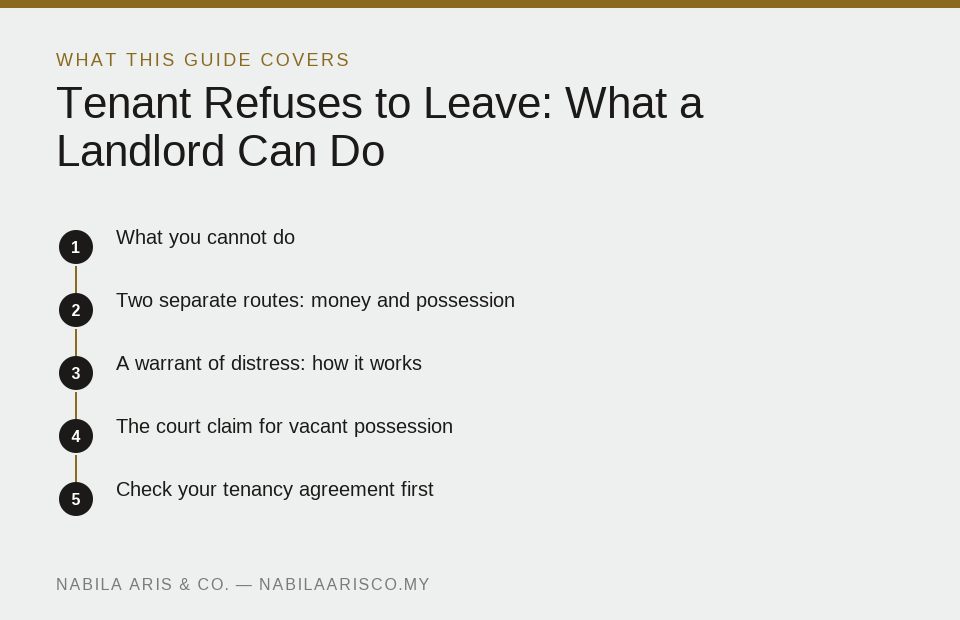
What this tenant refuses to leave guide covers
A tenant who refuses to leave after the term expires is among the most common tenancy disputes that reach us. Three months of rent unpaid, and the tenant is still there. The first instinct of most landlords is to change the locks. That is the single most costly step available.
When a tenant refuses to leave, this is what you cannot do
Section 7(2) of the Specific Relief Act 1950 provides that where a tenancy has ended but the occupier remains, the landlord must not enforce the right to recover possession otherwise than by proceedings in court.
In practice that means:
- You cannot change the locks
- You cannot remove the tenant or their belongings by force
- You cannot bar the tenant from re-entering
The text of the Specific Relief Act 1950 and the Distress Act 1951 can be checked on the Laws of Malaysia portal.
A landlord who does becomes the party being claimed against rather than the party claiming. A tenant who merely owed rent can end up with a claim against the landlord, and your position in your own original claim becomes weaker.
This is not a small technicality. It is the first thing a tenant solicitor will raise, and it changes the whole case.
A landlord cannot change the locks or remove a tenant by force. Possession can only be recovered by proceedings in court, and acting alone weakens your own position.
When a tenant refuses to leave: two separate routes
Many landlords assume one action deals with both. It does not.
To recover the rent arrears, there is the distress procedure under the Distress Act 1951. It seizes the tenant movable property and sells it to meet the arrears.
To recover the premises, you need a court claim for vacant possession. Distress does not remove a tenant.
Both can be run, but they are two separate things with separate procedures. Choosing one when you need both is a common cause of delay.
A warrant of distress: how it works
The application is made ex parte to a Judge or Registrar for a warrant of distress, supported by an affidavit in the prescribed form. If an agent applies on the landlord behalf, the agent has to produce written authority.
Its main advantage: you do not need a court judgment on the debt first. That makes it considerably faster than an ordinary claim.
The most important limit: distress can only recover arrears for a maximum of twelve completed months immediately before the date of the application. Arrears older than that cannot be recovered this way. So waiting two years before acting means half your arrears fall outside the scope of distress.
The timetable once the warrant is obtained:
- The bailiff or sheriff seizes the movable property, then immediately makes an inventory and an approximate valuation, and gives notice of seizure
- The notice states the amount due and that the goods will be sold at public auction unless payment is made within five days, or a court order restraining the sale is obtained
- The sale cannot take place less than six days after the notice
- The tenant and other occupants may apply under sections 10 and 16 to discharge or suspend the warrant, or to release part of the seized property, within seven days of the seizure
Two further notes. Distress can still be levied after the tenancy has ended, so long as the tenant remains in occupation or their goods remain on the premises. And this route is for landlords only. A licensor cannot use it against a licensee, following Kandasami v Mohamed Mustafa. So whether your document is a tenancy or a licence decides whether this route is open at all.
The court claim for vacant possession
The claim is usually combined: arrears of rent, vacant possession, and mesne profits, meaning compensation for the period the tenant continues in occupation after the tenancy ends.
Mesne profits are frequently overlooked. They mean a tenant who holds over for eight months owes not only the old arrears but compensation for those eight months as well.
The forum depends on the value of the claim. The Magistrates Court or the Sessions Court for smaller claims, and the High Court for claims above the subordinate court limits.
Before terminating a tenancy for non-payment, the usual step is to serve a formal notice demanding the arrears and allowing a reasonable time to pay. That notice is not a formality. It is what shows the court the termination was properly made.
If a tenant refuses to leave, check your tenancy agreement first
Before any step, three things in your documents decide how strong your position is.
The forfeiture clause and the notice provisions. What the agreement provides when rent goes unpaid, how many days notice is required, and to which address notice has to be sent. A notice served in a way the agreement does not provide for can be challenged.
Whether the agreement has been stamped. This is often neglected and it can cripple your case. An instrument that is not duly stamped may not be usable as evidence until the duty and penalty are paid. A landlord who never stamped the tenancy discovers this on the day the document is needed in court. The rates and penalties are in our tenancy stamp duty guide.
Whether it is a tenancy or a licence. That distinction decides whether the distress route is open to you at all.
If the tenant has left but the belongings have not
Do not throw them out. The tenant goods remain theirs, and disposing of them can found a claim against you even though they owe rent.
Make a written inventory and take dated photographs. Store the items safely. Send written notice to the last known address saying where the goods are held and giving a period to collect them.
Where there are arrears and the goods are still on the premises, the distress route may suit better than storing them yourself, because distress provides a lawful mechanism to sell them. Take advice before touching anything.
How to reduce the risk on the next tenancy
- Stamp the tenancy within the prescribed period, every time. The duty costs far less than not being able to use the document later
- Include a clear forfeiture clause with a sensible notice period and a practical method of service
- Take an adequate rental and utilities deposit, and state clearly what each may be applied to
- Record meter readings and the condition of the premises with dated photographs on the day the tenant moves in
- Do not let arrears run past two months without written notice. The twelve month limit in distress means waiting has a price
That last point costs landlords the most. Waiting because you do not want the conflict is a rational choice in month one and an expensive one in month fourteen. Reviewing a tenancy agreement is part of our tenancy agreement work.
I appointed them to handle my parents property matter and everything was handled smoothly and professionally. She explained everything clearly, was very patient with all of our questions and kept us updated throughout the process.
Athirah Azham · Google
Patient, takes the time to explain every term and procedure in detail, and has been very efficient in providing timely updates throughout the process. Whether you are purchasing a home for the first time or have been through the process before.
Aifa Azmi · Google
Excellent service throughout my property transfer transaction. The conveyancing team was professional, responsive, and efficient, keeping me informed at every stage.
Marina Mardi · Google
Rated 5.0 from 9 Google reviews.
Frequently asked questions about tenant refuses to leave
Can I change the locks?
No. Section 7(2) of the Specific Relief Act 1950 requires possession to be recovered only through court proceedings. A landlord who changes the locks can turn from the party claiming into the party being claimed against.
Does a warrant of distress remove the tenant?
No. Distress seizes movable property to meet rent arrears. To recover the premises you need a court claim for vacant possession. They are two separate things.
How far back can arrears be recovered through distress?
A maximum of twelve completed months before the date of the application. Older arrears cannot be recovered this way.
Do I need a judgment before applying for a warrant of distress?
No. The application is made ex parte to a Judge or Registrar with an affidavit in the prescribed form, without a prior judgment on the debt.
My tenancy agreement was never stamped. Is that a problem?
Yes. An instrument that is not duly stamped may not be usable as evidence until the duty and penalty are paid. It is discovered on the day you need the document in court.
The tenant has gone but left belongings. Can I throw them out?
Do not. The goods remain theirs and disposing of them can found a claim against you. Make an inventory, take dated photographs, store them safely, and send written notice.
Ready to start your property matter?
An initial consultation with no obligation. Tell us about your matter and we will explain what is involved and what it is likely to cost.
No 1, Jalan Setia Dagang AL U13/AL, Setia Alam, 40170 Shah Alam, Selangor
014-4004293 · Monday to Friday, 9:00am to 5:00pm