Vesting Order and LPPSA: When It Applies
A vesting order is not something that comes out of your own financing. An LPPSA vesting order problem almost always sits on the seller side, where the charge on the title is still in the name of an older entity and has to be cleared before anything new can be registered. This page sets out […]
Updated 14 November 2026 · Written and reviewed by Nur Nabilah Binti Mohd Aris

A vesting order rarely comes out of your own financing. It comes up where the seller charge is still registered to a bank that has merged or changed name, and that discharge has to be registered before your transfer and the security for your financing can go on the title. Run an official title search before you sign.
What this LPPSA vesting order guide covers
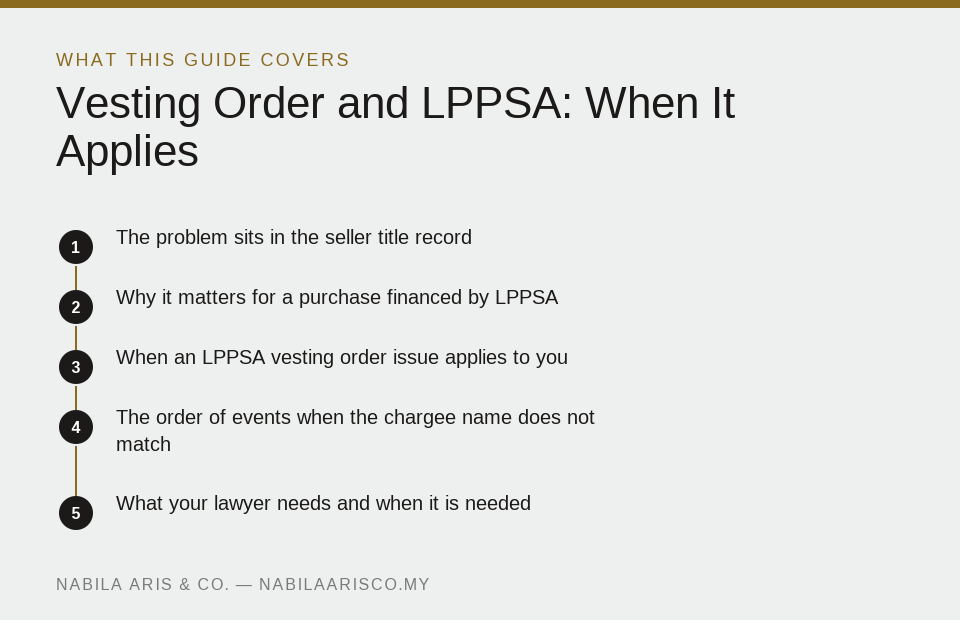
A vesting order is not something that comes out of your own financing. An LPPSA vesting order problem almost always sits on the seller side, where the charge on the title is still in the name of an older entity and has to be cleared before anything new can be registered. This page sets out where that situation touches a purchase financed by LPPSA.
The problem sits in the seller title record
A vesting order places rights over a property in another party without an ordinary transfer. In day to day practice it most often concerns the rights of a bank as chargee.
When a bank merges or changes its name, the charge on the title stays in the old name. The registrar has no way to connect the bank issuing the redemption statement today with the name recorded on the title.
So this has nothing to do with your eligibility or the terms of your financing. It belongs to the record of the property you are buying, and it is found through the official title search.
Why it matters for a purchase financed by LPPSA
The order of registration cannot be rearranged. The seller charge has to be discharged, the transfer has to be registered in your name, and the security for your financing has to be registered on the same title.
If the discharge stalls, the two steps after it stall with it. No party can skip the sequence, and that includes the financing side.
For LPPSA financing the security is registered in favour of the Government. That registration waits for a clean title in the same way any bank charge does.
When an LPPSA vesting order issue applies to you
The first situation is the common one. The seller charge is still registered to a bank that has since merged or been renamed.
The second is a court order directing the registrar to register a dealing on that title, including in an estate distribution.
The third is a property held by a trustee where the trustee has changed.
In all three the effect on you is the same. Registration waits until the chain of rights can be proved to the registrar of titles.
A redemption statement is not proof enough. It is issued in the current bank name and says nothing about the name recorded on the title.
The order of events when the chargee name does not match
The lawyer runs the official search, then compares the chargee name on the title against the bank name on the seller redemption statement.
If the two differ, the seller bank has to produce the vesting instrument or the certificate of merger as proof of the chain. These papers usually come from the bank documentation unit rather than the branch.
Once they are in hand, the discharge of charge can be lodged for registration. Only after that can the transfer be registered in your name.
Each step depends on the one before it. Your financing documents may be ready earlier, but they still wait for this sequence to finish.
What your lawyer needs and when it is needed
Your lawyer needs a certified copy of the vesting instrument, the certificate of merger or change of entity name, and a redemption statement that quotes the title number and the registered charge details.
None of those are your documents. The seller has to request them from the bank, and the turnaround is outside your control and outside the control of the lawyer.
Ask for the status of those papers before the completion date is fixed. Once the agreement is signed, the only option left is to ask the seller for an extension.
What it does to the completion period
A bank financed subsale normally runs three to four months from signing to the title changing name. LPPSA financing moves through a different approval sequence, so the period is already longer than that at the start.
A vesting problem on the title you are buying adds time on top of a period that is already long. It cannot be speeded up from outside.
The consequence is practical. If the completion period in the agreement is set tight, you may have to ask for an extension and carry late interest, even though the delay did not come from you.
That is why the completion period should be negotiated with more room as soon as the search shows a chargee name that does not match.
What an LPPSA vesting order delay costs you
LPPSA finances the legal fees for the financing documentation only. Work on the seller discharge, and on proving the chain of chargees, is not part of your financing documentation.
The agreement legal fees, the cost of transfer, the caveat, stamp duty and the statutory declaration are not financed either. Those stay with you even when the delay comes from the seller side.
Repeat searches are the cost people forget. When a matter hangs for months, the searches have to be refreshed before registration.
Obtaining the vesting papers from the bank is the seller expense. Put in the agreement who carries it, so it does not turn into an argument in the final month.
Where buyers go wrong in this situation
The most common error is signing the agreement before the official search is done. By the time the problem surfaces, the clock has already started.
The second is accepting the redemption statement as proof enough. It is issued in the current bank name and says nothing about the name recorded on the title.
The third is assuming the financing side can push the registration through. The land office works on sequence and documentary proof, not on pressure from any party.
The fourth is leaving arrears to the end. The land office will not register a transfer while quit rent is outstanding, and a strata matter needs a management body support letter, which is not issued while maintenance charges are in arrears.
A vesting order is not the same as perfection of charge
The two terms get mixed up. A vesting order concerns the chain of rights of a chargee or of a party entitled, and it is usually an issue on the seller side.
Perfection comes up where the property was bought before the individual title issued, so the transfer and the charge have to be completed later. The guide to an LPPSA purchase covers that situation.
Where no individual or strata title has issued, the sale runs on a deed of assignment and needs the developer consent. At that point there is no charge on a title to discharge, so no vesting question arises yet.
What to do before you sign
Get an official title search before you sign anything. Compare the chargee name there against the bank name on the most recent seller loan statement.
If the two do not match, ask the seller to start on the vesting papers the same day. Waiting until the agreement is signed only shortens the time you have.
Tell a lawyer who handles LPPSA matters about your financing at the discussion stage, so the completion period is negotiated against both timelines at once.
An LPPSA vesting order risk is cheapest to deal with before signing. After that it becomes a question of extensions and late interest, and both carry a price.
If your purchase is financed by LPPSA and a vesting order is holding up the seller title, that is work an LPPSA financing lawyer deals with directly.
I appointed them to handle my parents property matter and everything was handled smoothly and professionally. She explained everything clearly, was very patient with all of our questions and kept us updated throughout the process.
Athirah Azham · Google
Patient, takes the time to explain every term and procedure in detail, and has been very efficient in providing timely updates throughout the process. Whether you are purchasing a home for the first time or have been through the process before.
Aifa Azmi · Google
Excellent service throughout my property transfer transaction. The conveyancing team was professional, responsive, and efficient, keeping me informed at every stage.
Marina Mardi · Google
Rated 5.0 from 9 Google reviews.
Frequently asked questions about LPPSA vesting order
How does a vesting order affect LPPSA financing?
Through the seller title record. The old charge has to be discharged before your transfer and the security for your financing can be registered.
Who obtains the vesting papers?
The seller, through the bank. They come from the bank documentation unit, and the turnaround is outside the control of the lawyer.
How do I find out early?
From the official title search. Compare the chargee name on the title against the bank name on the seller loan statement.
Who has to deal with the vesting papers?
The seller, through the bank that holds the charge. You cannot request them yourself, so what you can do is ask in writing and record the date of each request.
Is my financing affected if registration is delayed?
Your approval is a separate matter from the seller title record, and what stalls is the registration. If the delay runs long, refer the position to LPPSA, since cancellation of financing is one of the categories LPPSA handles itself.
How long do the papers take to come through?
That depends on the bank and no lawyer can promise a date. They are usually pulled from a documentation unit or an archive rather than from a branch, so count in weeks rather than days.
Can the transfer be registered first and the charge sorted out later?
No. The seller discharge has to be registered first. The sequence is set by the title record, not by what the buyer and seller agree between themselves.
Ready to start your property matter?
An initial consultation with no obligation. Tell us about your matter and we will explain what is involved and what it is likely to cost.
No 1, Jalan Setia Dagang AL U13/AL, Setia Alam, 40170 Shah Alam, Selangor
014-4004293 · Monday to Friday, 9:00am to 5:00pm